
Research
Top 7 HFT-Friendly Prop Firms: The Ultimate List for Your Trading Robot (EA)
Dec
The top HFT-friendly prop firms include FundedNext, True Forex Funds, Kortana FX, FTMO, The Funded Trader, SurgeTrader, and Alpha Capital Group. These firms are recognized for their explicit rules allowing Expert Advisors (EAs), low-latency server infrastructure, and competitive trading conditions. They provide the necessary technological environment for high-frequency trading strategies to operate efficiently. For traders relying on automated systems, selecting a firm that supports this style is a primary step toward success in funded trading challenges.
A prop firm is considered ‘HFT-friendly’ when it offers an ecosystem built for speed and automation. This means having servers located near major liquidity providers to reduce execution time, offering minimal spreads and commissions to protect thin profit margins, and imposing no restrictions on news trading or scalping. These characteristics are fundamental for HFT robots that depend on executing a large volume of trades in very short timeframes to generate profits.
When comparing these top firms, you should assess key metrics against your specific trading strategy. The most important factors include the cost of the challenge relative to the account size, the profit split percentage, maximum drawdown limits, and the firm’s specific stance on strategies like arbitrage or martingale. Each firm presents a different combination of these elements, making one a better fit than another depending on your robot’s risk profile and performance metrics.
It is generally permitted to use HFT robots in prop firm challenges, but this always comes with conditions. Most firms that allow EAs have specific rules in their terms of service to prevent system abuse. This often includes restrictions on latency arbitrage, high-frequency tick scalping, or using identical strategies as a large group of other traders. Therefore, reading and fully grasping the rules of any prop firm before committing is a non-negotiable step for any automated trader.
What Makes a Prop Firm ‘HFT-Friendly’?
A prop firm becomes ‘HFT-friendly’ when its infrastructure and rules are explicitly designed to support automated, high-volume trading, characterized by low latency, minimal trading costs, and permissive strategy guidelines. A firm’s suitability for High-Frequency Trading (HFT) and Expert Advisors (EAs) is not an accident; it is the result of deliberate technological and policy choices. For a trader using an EA, these factors determine whether their strategy can be deployed as intended or if it will be hindered by poor execution and restrictive rules.
To understand this better, let’s break down the core attributes that define an HFT-friendly environment.

First, the firm must have explicit rules that permit the use of HFT and EAs. This is the most basic requirement. Many firms have vague terms of service, while others outright ban specific automated strategies. A truly HFT-friendly firm will state clearly in its FAQ or terms and conditions that EAs are welcome. They may specify which types of strategies are not allowed, such as certain arbitrage methods, but the general use of trading robots is accepted. This transparency gives traders confidence that their account will not be terminated for using an automated system.
Second, low latency and fast execution speeds are non-negotiable. HFT strategies live and die by speed. A delay of even a few milliseconds can turn a profitable trade into a losing one. These firms invest in high-end server infrastructure, often co-located in major data centers like London (LD4/LD5) or New York (NY4), where the world’s largest liquidity providers are housed. This physical proximity dramatically reduces the time it takes for a trade order to travel from the firm’s server to the liquidity provider and back, minimizing lag and improving fill quality.
Third, low spreads and commissions are essential. HFT strategies often aim for very small profits on a large number of trades, a method known as scalping. High transaction costs can easily erase these small gains. HFT-friendly firms partner with top-tier brokers and liquidity providers to offer raw or near-raw spreads on major currency pairs and indices. They complement this with a competitive commission structure, allowing automated strategies to operate within their intended profit margins.
Fourth, there should be no restrictions on news trading or scalping. Some prop firms disable trading or widen spreads during major news events due to high volatility. Others have rules against holding trades for less than a few seconds or minutes. An HFT-friendly firm will allow traders to operate freely during all market conditions. This freedom is necessary for EAs designed to capitalize on the volatility of news releases or for scalping bots that open and close positions in seconds.
Finally, the quality of liquidity providers is a key factor. A firm with deep liquidity from multiple top-tier banks and financial institutions can handle large order volumes without significant price slippage. Slippage is the difference between the expected price of a trade and the price at which the trade is actually executed. For HFT, where profits are measured in pips or fractions of a pip, consistent slippage can destroy a strategy’s profitability. High-quality liquidity helps ensure that trades are filled at or very close to the expected price, even during fast-moving markets.
Which are the Top 7 Prop Firms for HFT and EA Trading?
There are seven top prop firms well-suited for HFT and EA trading: FundedNext, True Forex Funds, Kortana FX, FTMO, The Funded Trader, SurgeTrader, and Alpha Capital Group. These firms have been selected based on their allowance of EAs, quality of execution, and overall trading conditions favorable to automated systems.
Here is a detailed look at why each of these firms stands out for traders using robotic systems.
Why is FundedNext Considered a Top Choice for HFT Traders?
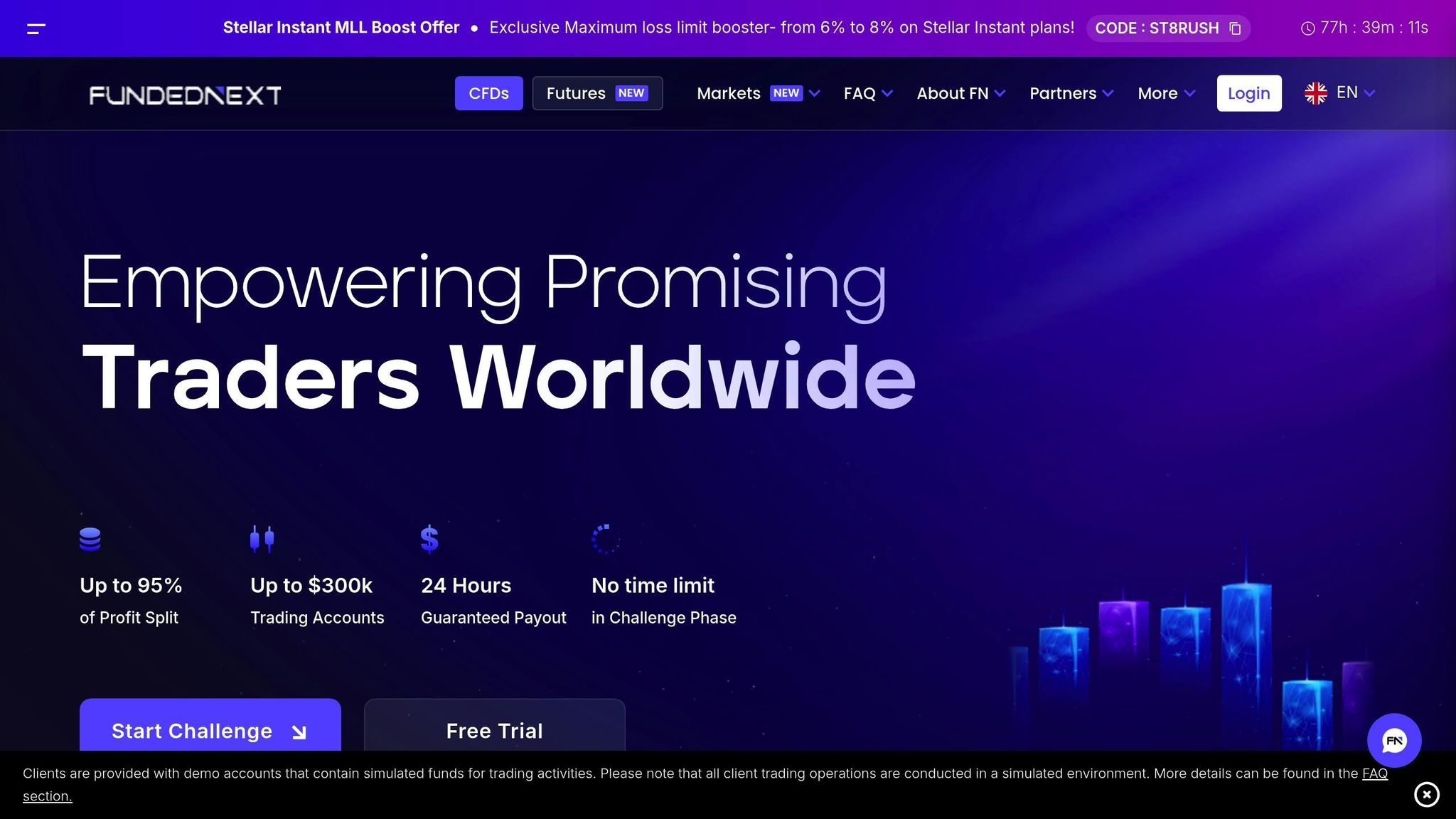
FundedNext is considered a top choice for HFT traders because it explicitly allows the use of EAs, offers very low commissions, and provides access to raw spreads through its partnership with a reputable broker. The firm’s infrastructure is built to support various trading styles, including high-frequency systems. This commitment is reflected in its clear rules and favorable trading conditions, which are designed to give automated traders a fair chance at passing challenges and securing funding.
To elaborate further, FundedNext’s rules are a major draw. The company permits all types of trading robots as long as they do not engage in prohibited practices like latency arbitrage or multi-account copy trading using the same strategy. This clear guideline removes ambiguity and lets traders deploy their EAs with confidence.
The funding models at FundedNext are also advantageous. They offer both one-step and two-step evaluation challenges, providing flexibility for different risk appetites. The profit split is generous, starting at 80% and scaling up to 90% for successful traders. This high-payout structure is particularly appealing for HFT strategies that can generate consistent returns.
From a technology standpoint, FundedNext utilizes servers from GrowthNext, which is partnered with top-tier liquidity providers. This ensures a low-latency environment with fast execution speeds, a critical component for any HFT strategy. The combination of raw spreads and a low commission of $3 per round lot on currency pairs and commodities helps protect the thin profit margins typical of high-frequency trading. The firm’s commitment to providing a technologically sound environment makes it a reliable platform for automated systems.
What are the HFT Advantages Offered by True Forex Funds?
The HFT advantages offered by True Forex Funds stem from its one-phase funding challenge, relaxed trading rules with no time limits, and the provision of both MT4 and MT5 platforms. These features create a flexible and straightforward environment for automated systems, which can operate without the pressure of a time constraint or complex multi-stage evaluation rules. True Forex Funds has positioned itself as a provider that prioritizes simplicity and freedom for traders.
Let’s see the specifics. The firm’s primary offering is a one-phase challenge, which simplifies the evaluation process. An EA only needs to hit a 10% profit target without breaching the maximum drawdown rules to get funded. This is much less complex than two-phase challenges, where a robot has to perform well across two different periods. The absence of a minimum trading days requirement or a time limit on the challenge gives an EA the freedom to trade only when its optimal conditions are met.
In terms of trading platforms, True Forex Funds offers MetaTrader 4 (MT4) and MetaTrader 5 (MT5), the industry standards for automated trading. This ensures broad compatibility with the vast majority of commercial and custom-built EAs. The firm also provides cTrader on request, which is known for its advanced charting and order execution capabilities, appealing to some automated traders.
A unique benefit for automated systems is the firm’s clear stance on trading styles. True Forex Funds allows news trading, scalping, and holding positions over the weekend. Their rules are permissive, focusing mainly on preventing abuse such as group copy trading or high-risk martingale strategies that could jeopardize the firm’s capital. This open approach allows a wide range of HFT strategies to be deployed without fear of rule violations, making it a strong contender for EA traders.
How does Kortana FX Support High-Frequency Trading Robots?
Kortana FX supports high-frequency trading robots through its highly flexible trading rules, bi-weekly payouts, and a unique three-phase funding model that allows for rapid scaling. The firm has built a reputation for being one of the most EA-friendly options available, actively encouraging the use of automated systems and providing conditions where they can thrive. This support is evident in its fee structure, instrument offerings, and specific guidelines.
Let’s break down its support system. Kortana FX’s fee structure is competitive, with evaluation fees that are refundable upon receiving the first profit split. This lowers the barrier to entry for traders wanting to test their EAs. The firm offers a wide array of tradable instruments, including forex, crypto, indices, and commodities, giving automated strategies diverse markets to operate in.
The rules at Kortana FX are particularly favorable for EAs. They do not have consistency rules, which often penalize automated systems that may have sporadic but highly profitable trading days. The firm also allows news trading and does not impose a minimum time limit on trades, perfect for scalping robots. Their primary restriction is on “group hedging,” where multiple accounts coordinate to exploit the system, a standard rule among legitimate prop firms.
Perhaps the most compelling feature is the support for scaling. Traders who pass the evaluation receive a funded account, and they can scale their capital quickly based on performance. The bi-weekly payout schedule is also a major plus, as it allows traders to access their profits more frequently compared to the monthly standard at many other firms. This combination of flexible rules, frequent payouts, and scaling opportunities makes Kortana FX a very attractive environment for deploying high-frequency trading robots.
Is The Funded Trader a Reliable Prop Firm for Automated Trading?
Yes, The Funded Trader is a reliable prop firm for automated trading due to its strong community reputation, transparent rules, and a variety of challenge types that cater to different EAs. The firm has established itself as a major player in the industry, known for its active community engagement and straightforward terms of service. For traders who value trust and clarity, The Funded Trader provides a solid foundation for deploying automated strategies.

Let’s explore its reliability. The firm’s reputation is one of its strongest assets. With a large and active community on platforms like Discord, traders can get real-time feedback and support. This transparency extends to its rules, which are clearly outlined and easy to understand. The Funded Trader permits the use of EAs on all its accounts, with standard restrictions against practices like copy trading from signals, latency arbitrage, or reverse arbitrage.
The evaluation process at The Funded Trader is versatile. They offer Standard, Rapid, and Royal challenges, each with different rules regarding profit targets, drawdown, and time limits. For example, the Rapid challenge offers a faster evaluation with no minimum trading days, which can be ideal for an HFT robot that meets its profit target quickly. The Royal challenge provides higher leverage, which may benefit certain automated strategies.
Customer support is another area where the firm performs well. They offer responsive support through live chat and their Discord community, which is helpful if a trader encounters any technical issues with their EA or platform. The terms of their evaluation are fair, with realistic profit targets and drawdown limits. The combination of a strong reputation, flexible challenge options, and clear rules makes The Funded Trader a dependable choice for automated trading.
What specific rules make SurgeTrader suitable for EAs?
Specific rules that make SurgeTrader suitable for EAs include its simple one-step evaluation, no time limits on challenges, and the allowance of all trading styles, including news trading and scalping. SurgeTrader simplifies the path to funding by removing many of the complex rules and time pressures found at other firms. This straightforward approach is highly beneficial for automated systems, which perform best in a consistent and predictable trading environment.
To see this more clearly, let’s look at the details. The core of SurgeTrader’s offering is its single-step audition. Traders only need to achieve a 10% profit target to get funded, without having to pass a second phase. This direct path reduces the probability of an EA failing due to changing market conditions over an extended evaluation period. Furthermore, there are no minimum or maximum trading day requirements, giving an EA complete freedom to execute its strategy on its own timeline.
SurgeTrader’s terms and conditions are very permissive. The firm explicitly states that all trading styles are welcome. This includes the use of EAs, scalping, and news trading. There are no rules about how long a trade must be held or consistency requirements. The primary restrictions are logical and designed to manage risk, such as a ban on using EAs that take advantage of demo server inefficiencies or engaging in high-risk strategies across multiple accounts.
Another key rule is their clear stance on copy trading. While they do not allow copy trading between different SurgeTrader accounts, they permit traders to use third-party copy trading services to copy trades from an external account to their SurgeTrader account, as long as the master account is their own. This provides flexibility for traders who may run their EA on a master account and want to replicate its performance on a prop firm challenge, making SurgeTrader a very practical choice for many EA users.
How does FTMO’s technology benefit HFT strategies?
FTMO’s technology benefits HFT strategies through its partnership with top-tier liquidity providers, its robust server infrastructure located in major financial hubs, and its custom-built trading applications that provide deep performance analytics. While FTMO is known for having stricter rules compared to other firms on this list, its technological foundation is undeniably top-notch, offering a stable and high-performance environment that can support certain types of automated strategies.

Let’s analyze their technological setup. FTMO partners with a pool of prime liquidity providers, which gives their traders access to institutional-grade liquidity. This results in very tight spreads and minimal slippage, especially on major forex pairs. For an HFT strategy where every fraction of a pip matters, this quality of execution is a significant advantage. Their servers are located in London, a major data center for forex trading, which helps reduce latency for traders connecting from Europe.
The trading platforms offered are MT4, MT5, and cTrader, all equipped with FTMO’s proprietary order execution technology. This setup is designed to replicate real market conditions as closely as possible, even during the challenge phase. This means an EA that performs well in an FTMO challenge is likely to perform similarly on a live funded account.
FTMO also offers a suite of custom applications, like the Mentor App and Account MetriX, which provide detailed analysis of a trader’s performance. For EA developers, this data is invaluable. It allows them to analyze their robot’s performance statistics, identify weaknesses, and optimize its strategy based on metrics like average win/loss, expectancy, and drawdown characteristics. Although FTMO has specific restrictions on strategies that exploit demo server discrepancies (like high-frequency arbitrage), its superior technology makes it a strong option for well-built EAs that rely on pure market analysis rather than system loopholes.
Why does Alpha Capital Group complete the list of HFT-friendly firms?
Alpha Capital Group completes the list of HFT-friendly firms because it offers a unique proprietary trading platform, excellent scaling opportunities, and a clear set of rules that accommodates most EA strategies. The firm provides a professional trading environment that is backed by solid technology and a focus on trader growth, making it a compelling choice for those looking to build a long-term career with their automated systems.

Let’s summarize its key features. One of the standout aspects of Alpha Capital Group is their proprietary platform, ACG Markets, which is built on cTrader. This platform offers advanced charting, Level II pricing, and fast order execution, which are all beneficial for HFT systems. They also provide MT5, giving traders a choice of platforms.
The firm’s rules are supportive of automated trading. They allow EAs, news trading, and weekend holding. The main restrictions are against manipulative practices like using guaranteed limit order fills or latency arbitrage, which are standard in the industry. The profit target for their two-phase challenge is a realistic 8% in phase one and 5% in phase two, with reasonable drawdown limits.
What truly sets Alpha Capital Group apart is its scaling plan. Traders who remain profitable can have their account size doubled every time they achieve a 10% profit target, up to a maximum of $2 million. This aggressive scaling plan is highly attractive for consistently profitable EAs. The combination of a professional trading environment, clear rules, and a focus on long-term growth makes Alpha Capital Group a fitting final addition to this list of top HFT-friendly prop firms.
How Do You Compare the Top HFT Prop Firms for Your EA?
You compare the top HFT prop firms by evaluating their challenge cost against account size, profit split percentage, maximum drawdown rules, allowable strategies, and server latency. While one firm may excel in one area, another might offer a better overall package for your specific Expert Advisor (EA). The best choice depends on your robot’s trading style, risk tolerance, and profitability metrics.
Let’s look at a detailed comparison across these key attributes to help you make a final decision.
A primary point of comparison is the Challenge Cost vs. Account Size. This is the initial investment required to start the evaluation. Firms like True Forex Funds and Kortana FX often offer competitive pricing for their challenges, providing good value. You should calculate the cost per $10,000 of funding to see which firm offers the most capital for your money. For example, a $500 fee for a $100,000 account is a better value than a $300 fee for a $50,000 account.
Next is the Profit Split Percentage. This determines how much of the profit you get to keep. Most firms on this list, including FundedNext and The Funded Trader, start with an 80/20 split in your favor and offer scaling plans that can increase your share to 90%. A higher profit split directly translates to more income from your EA’s performance, so this is a major factor for long-term profitability.
Maximum Drawdown Rules are also a critical element. These rules define how much you can lose before your account is terminated. There are two types: maximum daily drawdown and overall drawdown. Firms like FTMO have a stricter 5% daily drawdown, while others may offer a static overall drawdown that doesn’t trail your account’s high-water mark. You must choose a firm whose drawdown rules align with your EA’s historical worst-case performance to avoid failing the challenge.
The list of Allowable Trading Strategies is another important comparison point. While all firms on this list allow EAs, their specific rules on strategies like martingale, grid trading, or arbitrage can differ. For instance, FTMO has strict rules against arbitrage that exploits their system. SurgeTrader and Kortana FX tend to be more lenient. Always read the fine print to make sure your EA’s core logic does not violate any rules.
Finally, Server Latency is a key technical consideration. While most firms do not publish exact latency figures, you can get a good idea by checking their broker and server locations. Firms using brokers like Eightcap with servers in London (LD4/LD5) or New York (NY4) generally offer lower latency for traders in those regions. You can use a latency testing tool with the firm’s demo server to get an estimate before committing to a challenge. For an HFT EA, lower latency means better execution and less slippage.
Is it Permissible to Use HFT Robots in Prop Firm Challenges?
Yes, it is generally permissible to use HFT robots in prop firm challenges, but this permission is almost always subject to specific rules and restrictions defined by each firm. Most modern proprietary trading firms recognize that automated trading is a legitimate and widely used strategy. As a result, they have adapted their business models to accommodate Expert Advisors (EAs). However, their primary goal is to find skilled traders, not to allow individuals to exploit system loopholes.
To understand this better, let’s look at the nuances behind this permission.
The main reason firms allow EAs is to attract a wider pool of talent. Many of the most consistent and disciplined trading strategies are algorithmic. By allowing EAs, prop firms can identify and fund traders who have developed profitable, systematic approaches to the market. Firms like FundedNext, True Forex Funds, and Kortana FX openly state that EAs are welcome, as they are confident their execution environment can support legitimate strategies.
However, this allowance comes with important caveats. The rules are designed to filter out strategies that are not viable in a live market environment. For example, nearly every prop firm prohibits “latency arbitrage,” a strategy where an EA tries to profit from small delays between the price feed of the prop firm and another, faster feed. This is not considered a genuine trading skill but rather an exploitation of technology.
Another common restriction relates to “high-frequency tick scalping” on demo servers. Some EAs are designed to open and close trades within milliseconds to capture tiny price movements that only exist in a demo environment due to less precise price feeds. These strategies often fail in live market conditions where slippage and execution delays are present. Firms will often specify in their terms that such strategies are not allowed.
Furthermore, rules around copy trading are strict. You are usually allowed to use an EA that you own and run on your personal accounts. However, you are typically not allowed to use a third-party signal service or an EA that is being used by a large number of other traders in the same firm. This is to prevent large groups of traders from executing identical trades, which poses a significant risk management challenge for the firm. Before you use any HFT robot in a challenge, you must read the firm’s terms and conditions carefully to confirm your strategy is compliant.
What Advanced Considerations and Alternatives Exist for HFT Prop Trading?
Advanced traders should assess alternatives like direct API access, weigh the benefits of prop firms against personal broker accounts, and recognize which firms explicitly forbid high frequency strategies to make informed decisions. Additionally, understanding unique features such as ‘no slippage’ guarantees can provide a substantial edge in execution quality and overall profitability for automated systems.
Which Prop Firms Explicitly Forbid HFT or Arbitrage Strategies?
Many proprietary trading firms have specific rules that prohibit high frequency trading, latency arbitrage, and other strategies that exploit technological loopholes. This is often because their business model relies on copying trades to a live market, and ultra fast strategies cannot be replicated accurately by their liquidity providers. When a trader’s profits come from system inefficiencies rather than true market prediction, the firm may not be able to generate corresponding profits, leading to a conflict. Firms like FTMO and The5%ers have historically maintained strict rules against trading styles that could be defined as “exploitative,” including many forms of HFT. They often use terms like “gambling,” “overleveraging,” or “group trading” in their terms of service to cover these scenarios. Reading the fine print on a firm’s evaluation rules is absolutely necessary.

Looking for these prohibitions helps you avoid wasting time and money on a challenge you cannot win.
- Server Location Arbitrage: Many firms disallow strategies that take advantage of price feed differences between their servers and other brokers.
- Tick Scalping: Extremely short term trades that last less than a few seconds are often flagged and may lead to account termination.
- Exploiting Demo Environments: Some rules are in place to prevent traders from using strategies that only work in a simulated environment with no real market impact.
How Does Direct API Access Offer an Advantage Over MT4/MT5 for HFT?
Direct API access provides a faster and more direct connection for an HFT bot compared to the standard MT4 or MT5 platforms. The MetaTrader platforms act as an intermediary layer. Your trading robot sends a command, the platform processes it, and then sends it to the firm’s server. Each step introduces a small delay, measured in milliseconds. For normal trading, this delay is unnoticeable. For HFT, where trades are executed in fractions of a second, these milliseconds are the difference between a profitable strategy and a losing one. An API, or Application Programming Interface, bypasses this intermediary layer. It allows your trading robot to communicate directly with the firm’s trading server.

This direct line of communication delivers several key benefits for high speed algorithms.
- Lower Latency: By removing the MT4/MT5 processing layer, order execution speeds are substantially faster, which is the primary requirement for any HFT strategy.
- Greater Control and Flexibility: An API allows developers to use more powerful programming languages like Python or C++, offering more sophisticated possibilities than MQL4/MQL5.
- Customized Data Feeds: Traders can often stream raw, unfiltered tick data directly through the API, providing more accurate information for their algorithms to analyze.
Is it Better to Run an HFT Bot on a Prop Firm or a Personal Broker Account?
Choosing between a prop firm and a personal broker account for an HFT bot depends entirely on your capital, risk tolerance, and strategy. A prop firm offers the distinct advantage of trading with a large capital base without risking your own money. For a one time fee, you can gain control of an account worth hundreds of thousands of dollars. The profit splits, typically around 80% in your favor, are a trade off for this access to leverage. However, you are still operating within the firm’s ecosystem, subject to their rules, trading platforms, and choice of liquidity providers. Even HFT friendly firms will have some restrictions you must follow.

A personal broker account offers complete autonomy but comes with greater financial risk. You must fund the account entirely with your own capital.
- Pros of a Personal Account: You keep 100% of the profits. You have absolute freedom to choose your broker, platform, and strategy with no external rules other than the broker’s terms.
- Cons of a Personal Account: You bear 100% of any losses. Building up an account large enough to generate substantial income from HFT requires significant personal capital.
- The Hybrid Approach: Some traders use profits from a prop firm to build capital for their personal brokerage account, blending the benefits of both worlds.
What are ‘No Slippage’ Guarantees and How Do They Impact HFT Performance?
A ‘no slippage’ guarantee is a promise from a prop firm that your market or limit orders will be executed at the exact price you requested. Slippage occurs in fast moving markets when the price changes in the milliseconds between you sending an order and the server executing it. This can result in your trade being filled at a slightly worse price. For HFT strategies that rely on capturing very small price movements over thousands of trades, slippage can completely destroy profitability. A few fractions of a pip difference on every trade quickly adds up to substantial losses. This guarantee is a powerful feature because it eliminates a major variable that affects performance.
This type of execution quality is particularly valuable for automated systems.
- Predictable Results: It makes backtesting more reliable. If your strategy works on historical data, it has a much higher chance of working in a live environment without slippage.
- Preservation of Profit Margins: It protects the tiny profits that HFT bots are designed to capture, ensuring the strategy remains viable.
- Reduced Uncertainty: Traders can run their algorithms with confidence, knowing that unexpected execution costs will not suddenly turn a winning system into a losing one.
