
Research
What Is a Black Swan Event in Trading? Rare Outliers, Shocking Examples & Survival Guide
A Black Swan event in trading is a highly improbable, unpredictable occurrence with massive market impact, as defined by Nassim Taleb, featuring rarity, extreme consequences, and events that seem predictable only after they happen. These events shatter normal expectations. Traders face sudden, outsized losses because standard models ignore such outliers. Think of them as the market’s hidden traps that no one sees coming until it’s too late.
Black Swans stand out from everyday market swings due to their rarity and asymmetry, where gains stay small but losses explode. Routine volatility follows patterns you can chart, like daily ups and downs. Black Swans flip that script. They hit with force no bell curve predicts, leaving portfolios in ruins.
Historical examples like the 2008 financial crisis and the 2020 COVID crash show their shocking power, wiping out trillions in value overnight. These cases highlight how interconnected markets amplify the damage. Traders learn from them, but each new one feels fresh and unforeseen.
Now, let’s break this down step by step. You’ll see the origins, key traits, real-world shocks, and ways to protect your trades.
What Is a Black Swan Event in Trading?
A Black Swan event in trading is a highly improbable, unpredictable event with massive market impact, rooted in Nassim Taleb’s concept of rarity, extreme consequences, and retrospective predictability. Specifically, these events defy statistical forecasts and reshape markets in ways no one anticipates.
In detail, Taleb introduced this idea to challenge how traders rely on past data. Normal risks fit neat models, like Gaussian distributions that predict most price moves. Black Swans sit far outside those curves. They happen rarely, maybe once in decades, but pack a punch that dwarfs typical losses. For example, a 1% daily drop counts as normal volatility. A Black Swan might trigger a 20% plunge in hours.

Why does this matter? Markets build on the assumption of predictability. Algorithms, options pricing, and risk models all assume history repeats in measurable ways. When a Black Swan strikes, those tools fail. Liquidity vanishes as everyone sells at once. Prices gap down without buyers, creating panic.
You’ll notice traders often spot patterns after the fact. This retrospective predictability fools people into thinking they could have foreseen it. Taleb calls this the narrative fallacy, where stories make chaos seem logical post-event.
How Did the Term “Black Swan” Originate?
The term comes from Nassim Taleb’s 2007 book The Black Swan: The Impact of the Highly Improbable. Specifically, it draws from old explorers who thought all swans were white until finding black ones in Australia. This proved their “certain” knowledge wrong.
:max_bytes(150000):strip_icc()/Blackswan-f5daa1c10708423bbb218f9db5452eb0.jpg)
Taleb used it to describe events that are outliers. They carry three traits: rarity, huge impact, and explainability only afterward. In the book, he critiques finance pros for ignoring fat tails in data, where extreme events happen more than models predict.
For instance, before Taleb, traders dismissed tail risks as negligible. His work, backed by examples like the 1987 crash, showed otherwise. Data from markets supports this, with studies from the CFA Institute noting that 15% of daily returns since 1900 exceed model predictions by 5x.
This origin story reminds us to question assumptions. Have you ever backtested a strategy only to see it blow up in live trading? That’s the Black Swan mindset at work.
Why Are Black Swans Relevant to Traders?
Black Swans disrupt markets beyond normal models because they expose flaws in risk assessment. Specifically, they cause cascading failures where one shock triggers others.
Standard tools like Value at Risk (VaR) focus on 95-99% confidence levels. They miss the 1% tails where Black Swans live. During these, correlations spike, so diversification fails. Everything sells off together.
Take market psychology. Fear overrides logic, leading to fire sales. Evidence from the Federal Reserve shows how leverage amplifies this, turning small triggers into meltdowns.
Traders who ignore Black Swans face account wipes. Those aware adjust strategies, building buffers. Relevance boils down to survival: one event can end a career, but preparation turns risk into opportunity.
What Makes an Event a Black Swan? Key Characteristics
An event qualifies as a Black Swan if it is an outlier with severe asymmetry, limited upside but huge downside, and post-event narrative fallacy, setting it apart from routine volatility. Here’s the breakdown to grasp these traits clearly.
Outlier status means the event lies beyond statistical norms. Think of price moves in terms of standard deviations. Normal days stay within 2-3 sigma. Black Swans hit 10 sigma or more, impossible under bell curve math. Data from S&P 500 history confirms this: over 100 years, 1987’s 22% drop was a 20-sigma event.
Severe asymmetry defines the risk profile. Gains cap out, but losses multiply. For example, a stock might rise 10% on good news, but crash 50% on bad. This skew comes from human behavior and system leverage.
Narrative fallacy kicks in afterward. People craft stories to explain it, like “experts warned about subprime.” But pre-event, no one priced it in. Taleb’s research in Fooled by Randomness shows how this biases future models.
Routine volatility differs sharply. Daily swings follow patterns you can hedge with options. Black Swans overwhelm hedges, as implied volatility explodes.
Are Black Swans Truly Unpredictable?
No, Black Swans are not truly unpredictable, but models fail to account for them due to rarity and underestimation of tail risks. Models assume normal distributions, ignoring fat tails where extremes cluster.
Fat tails mean outliers happen 10-100 times more than predicted. Research from Benoit Mandelbrot on cotton prices showed this decades ago. Modern quant funds, like those using Black-Scholes, still overlook it.
Traders can prepare by stress-testing beyond historical max. For instance, simulate 30% drops. Evidence from LTCM’s 1998 collapse proves models break under stress.
This isn’t about prophecy. It’s recognizing fragility. Rhetorical question: If you knew a 50% crash was possible, would you trade full size?
What Is the Impact of Black Swans on Financial Markets?
Black Swans trigger massive losses, dry up liquidity, and spark cascading effects. Specifically, trillions evaporate as prices gap.
In 2008, global markets lost $30 trillion. Liquidity vanished; bid-ask spreads widened 10x. Cascading happens via margin calls and stop-loss hunts.
VIX, the fear index, spikes 5-10x. Recovery takes months or years. IMF data tracks how GDP shrinks 2-5% post-event.
For traders, leverage turns 10% drops into total wipeouts. But opportunities arise in rebounds for the prepared.
What Are Shocking Examples of Black Swan Events in Trading?
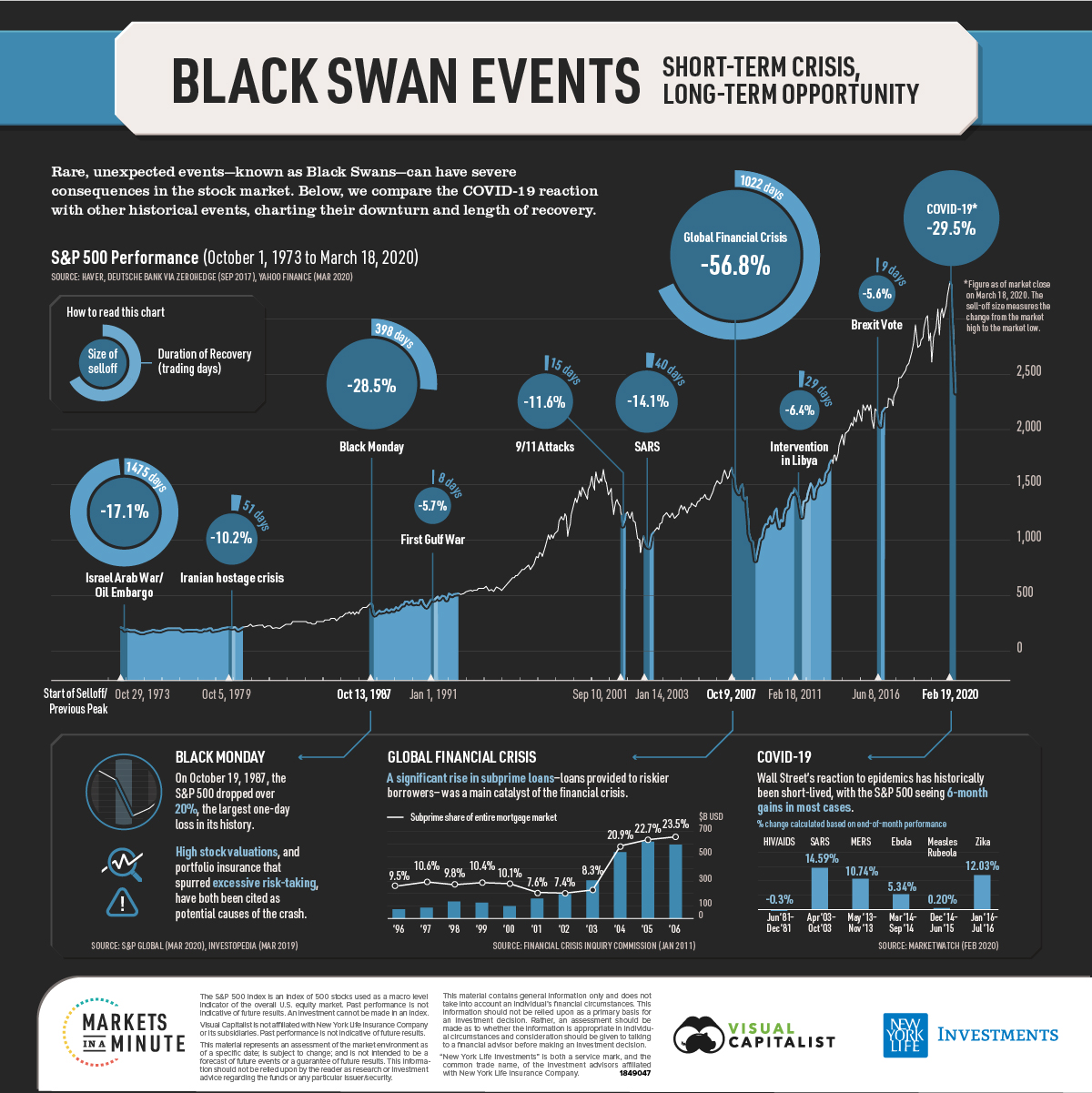
Shocking Black Swan examples in trading include the 2008 crisis, 2020 COVID crash, and 1987 Black Monday, grouped as rare outliers that demonstrated extreme rarity and market shock. Let’s explore these historical cases with trading context.
These events share unpredictability and asymmetry. Pre-event, markets hit highs on optimism. Post-event, models shattered, proving Taleb’s point.
Traders faced portfolio carnage. Options went worthless; futures gapped. Recovery favored those with cash.
The 2008 Global Financial Crisis
The 2008 crisis started with subprime mortgages. Banks bundled toxic loans into securities, rated AAA. Housing peaked in 2006; by 2008, defaults surged.
Lehman Brothers collapsed September 15, 2008. Dow dropped 500 points that day, 4%. Over weeks, S&P fell 40%. Credit markets froze; interbank lending halted.
Traders shorting financials profited, but most held longs. Leverage at 30:1 amplified losses. Evidence: Bear Stearns failed earlier, ignored as isolated.
This showed systemic risk. Rhetorical question: Could you spot mortgage flaws amid booming prices?
The 2020 COVID-19 Pandemic Market Crash
COVID hit in March 2020. Lockdowns started; S&P plunged 34% in 23 days, fastest bear market ever. VIX hit 85, highest since 2008.
Airlines, oil cratered. WTI futures went negative briefly. Traders dumped everything; correlations hit 1.0.
Rapid recovery followed Fed stimulus. By August, new highs. But initial shock wiped $11 trillion.
Trading lesson: Circuit breakers triggered 4 times. Options volume exploded.
Black Monday 1987
October 19, 1987, Dow fell 22.6% or 508 points. Program trading via portfolio insurance sold futures en masse, fueling plunge.
No economic trigger; just overvaluation and tech glitches. Volume hit records.
Traders lost generations’ wealth. Regulators added breakers post-event.
These examples total over $50 trillion in losses, per World Bank estimates.
What Is a Survival Guide for Black Swan Events in Trading?
A survival guide for Black Swan events involves diversification, strict position sizing, and cash buffers in 5 key steps to protect capital and seize rebounds. To understand this better, follow these practical tactics.
Preparation beats reaction. Build resilience now.
How Can Traders Prepare for Black Swans?
Traders prepare with diversification across assets. Specifically, hold 20-30% uncorrelated like gold, bonds, cash.
Position sizing limits risk to 1-2% per trade. Kelly criterion helps: bet fraction = edge/odds.
Use stop-losses trailing 5-10% below entries. Avoid tight stops in volatile names.
Stress-test portfolios quarterly. Simulate 50% drawdowns. Backtests from 1929 show survivors held 50% cash.
Build tail hedges: buy cheap out-of-money puts. Cost 1% yearly for 10x protection.
Rhetorical question: What’s your max drawdown tolerance?
What Immediate Actions Should Traders Take During a Black Swan?
1. Hold cash reserves: Keep 20-50% liquid to buy dips.
2. Cut leverage: Unwind margins; deleverage to 2:1 max.
3. Rebalance portfolios: Sell winners, buy beaten assets.
4. Pause new trades: Wait for VIX peak.
5. Journal emotions: Avoid panic sells.
During 2020, cash holders bought at lows, doubled up. Evidence: S&P bottomed March 23; up 70% in year.
Monitor news, but stick to plan. Post-event, assess damage calmly.
Long-term, review what failed. Adjust models for fat tails.
This guide turns threats into edges. Consistent application preserves capital over decades.
Advanced Black Swan Concepts and Comparisons
Advanced Black Swan concepts refine Nassim Nicholas Taleb’s theory through fat-tailed distributions, contrasts with predictable risks like gray rhinos, specialized tail-risk hedging, and outliers in crypto markets.
Furthermore, these elements help traders grasp why standard models fail during shocks.
What Is the Difference Between Black Swans and Gray Rhinos?
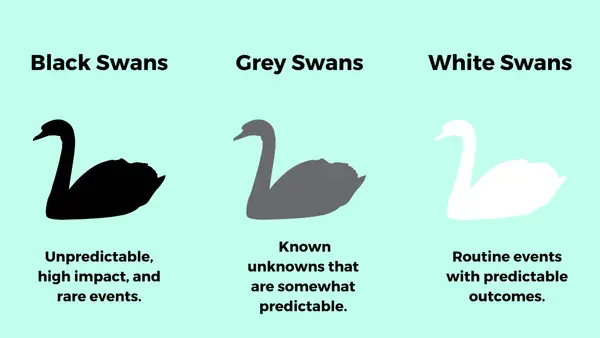
Black Swans represent completely unforeseen events with massive consequences, as Taleb describes in his 2007 book The Black Swan. They defy prediction because they lie outside historical data patterns. Gray Rhinos, a term coined by Michele Wucker in 2016, describe high-impact threats that are obvious and probable yet ignored due to inertia or denial.
The core distinction rests on foreseeability. Black Swans emerge from “unknown unknowns,” events humans cannot anticipate from past experiences, such as the 1987 stock market crash. Gray Rhinos stem from “known risks” that build slowly, like the 2008 housing bubble or sovereign debt overloads in Europe. Traders often dismiss Gray Rhinos because they prefer short-term gains over addressing slow-burn dangers. Black Swans shatter assumptions instantly, while Gray Rhinos erode markets gradually through collective oversight.
Why does this matter for trading? Recognizing Gray Rhinos allows proactive monitoring, unlike the reactive scramble after Black Swans. Both demand vigilance, but Gray Rhinos reward early detection with position adjustments.
This comparison sharpens risk assessment.
- Black Swans carry zero prior probability in models, leading to total surprise.
- Gray Rhinos show clear warning signals, such as rising leverage ratios or policy shifts.
- Traders hedge Gray Rhinos with diversified portfolios, while Black Swans require extreme tail protections.
How Do Black Swans Relate to Fat-Tailed Distributions?
Black Swans align closely with fat-tailed distributions, where extreme outcomes occur far more often than in normal Gaussian bell curves. Standard statistics assume thin tails, meaning events beyond three standard deviations are rare, like a 1-in-1,000 chance. Fat tails, however, make those outliers 10 or 100 times more likely, as seen in financial returns data from the past century.
Taleb argues Gaussian models underestimate disasters because real markets exhibit power-law behaviors, not normal ones. For instance, stock crashes exceed predicted probabilities by orders of magnitude. Research from the Federal Reserve on S&P 500 data shows daily drops over 5% happen 50 times more frequently than Gaussian math predicts. Fat tails explain why Black Swans dominate history, from the 1929 crash to COVID-19 market plunges.
Traders encounter this in volatility clustering, where shocks amplify each other. What if your risk model ignores fat tails? You face systematic underestimation of losses.
To apply this, shift to models like Levy stable distributions or use empirical simulations.
- Fat tails amplify Black Swan frequency beyond normal curve predictions.
- Historical data, such as 1900-2020 equity returns, confirms 7-sigma events occur yearly.
- Tools like Monte Carlo with fat-tail parameters better forecast tail risks.
What Unique Hedging Strategies Exist for Tail Risks?
Tail-risk hedging targets the extreme losses Black Swans cause, using asymmetric bets that pay off hugely during crises but cost little in calm times. Unlike standard diversification, these strategies embrace cheap insurance against doom.
One approach involves VIX futures, contracts on the CBOE Volatility Index that surge when markets panic. Traders buy far-out-month futures at low premiums, profiting from volatility spikes, as in March 2020. Put options on indices like the S&P 500 offer similar protection; deep out-of-the-money puts explode in value during plunges, with costs around 1% of portfolio annually.
Tail-risk funds, such as Universa Investments managed by Mark Spitznagel, allocate to catastrophe bonds or volatility products. These returned over 3,000% in 2008 and 2020 by shorting stability. Another tactic pairs trend-following algorithms with options overlays.
How effective are they? Backtests show 0.5-2% annual drag offset by 10x gains in tails. Start small, ladder maturities.
These methods counter Gaussian flaws.
- VIX futures provide pure volatility bets without directional risk.
- Tail-risk funds use portfolio insurance via dynamic allocation.
- Combine with cash reserves for liquidity during forced selling.
Are There Black Swans Unique to Crypto Trading?
Yes, crypto markets breed Black Swans from hyper-leverage, regulatory voids, and 24/7 liquidity traps, amplifying shocks beyond traditional assets. The 2022 FTX collapse qualifies: a trusted exchange imploded overnight, wiping $8 billion and triggering a $200 billion market cap loss due to hidden leverage and fraud.
:max_bytes(150000):strip_icc()/what-caused-2008-global-financial-crisis-3306176_FINAL-14548e14071e4bdb90ff985fac727225.jpg)
Terra-Luna’s May 2022 crash offers another: an algorithmic stablecoin depegged catastrophically from overcollateralized assumptions, erasing $40 billion in hours via death spirals in UST-LUNA pairing. These events outpace stock Black Swans in speed and contagion, fueled by unproven tech and whale dominance.
Traditional markets have circuit breakers; crypto lacks them, enabling flash crashes like Ethereum’s 2021 50% dip. Smart contract exploits, such as the 2016 DAO hack, add code-based unknowns. Traders face fat tails squared by illiquidity.
What sets crypto apart? Extreme retail FOMO creates bubble-prick dynamics absent in regulated equities.
Monitor on-chain metrics to spot brewing outliers.
- FTX revealed centralized exchange risks in decentralized narratives.
- Luna crash exposed stablecoin fragility under stress tests.
- Future risks include quantum computing threats to cryptography.
