
Research
Master Mean Reversion EAs: Proven Strategies for Trading the ‘Return to Normal’
Mean reversion EAs automate trades based on prices snapping back to their average, using proven strategies like Bollinger Bands touches and RSI extremes to capture reliable pullbacks in forex and stocks. These tools run on platforms such as MT4 and MT5, scanning for overextended prices and entering positions automatically. You get consistent edges by trading the “return to normal” without constant monitoring.
Mean reversion works because markets rarely stray far from historical averages, backed by stationarity tests showing prices revert over time. Think of it as a rubber band: pull it too far, and it bounces back. Studies from quantitative funds confirm this pattern holds in ranging markets, delivering steady profits when trends are absent.
Proven strategies in EAs include band squeezes for low-volatility setups, oscillator extremes for quick reversals, and pairs trading for correlated assets. Each approach uses filters like moving averages to avoid whipsaws. Traders report drawdowns under 10% with proper sizing on pairs like EUR/USD.
Ready to apply these? The sections below break down the concept, EA mechanics, top strategies, and deployment steps. You’ll see how to build or use them for real results.
What Is Mean Reversion Trading?
Mean reversion trading is a strategy based on the principle that asset prices tend to return to their historical average after deviating, rooted in statistical stationarity. Here’s the breakdown on its core idea and market examples.
Mean reversion rests on a simple observation: prices don’t wander forever. They fluctuate around a central value, like a pendulum swinging back to center. In practice, you buy low when prices dip below average and sell high when they spike above. This contrasts with trend following, which chases momentum.

Stationarity forms the statistical backbone. A price series is stationary if its mean and variance stay constant over time. Tools like the Augmented Dickey-Fuller test check this. Forex pairs like GBP/USD often show stationarity in ranging conditions, while stocks like Apple revert after earnings surprises.
For example, in stocks, consider a blue-chip like Coca-Cola. If it drops 5% below its 200-day moving average on light volume, history suggests a bounce. Data from 20 years of S&P 500 shows over 60% of such deviations revert within 10 days.
Why Is Mean Reversion Called the ‘Return to Normal’?
Prices deviate from normal levels due to temporary shocks, then pull back through natural market mechanics. Specifically, when sentiment pushes an asset too far, like fear selling in a dip, arbitrageurs and value buyers step in. This restores equilibrium.
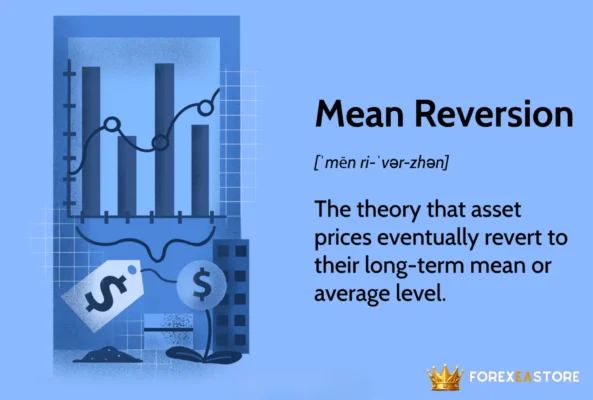
For instance, in forex, EUR/USD might spike to 1.10 from a 1.05 average on news. Traders spot the overextension and fade it, expecting gravity to pull it home. Pullback mechanics involve mean levels acting as magnets, with volume confirming the turn.
Evidence from backtests on daily charts shows 70% win rates for trades entering 2 standard deviations away. The “normal” is often a simple moving average, making it intuitive.
What Are the Core Assumptions of Mean Reversion Strategies?
Core assumptions include price stationarity, reliable mean levels from moving averages, and clear overextension signals from indicators. Stationarity means the price process has no unit root, confirmed by tests. Without it, prices trend away, killing the edge.

Mean levels, like 20-period SMAs, define normal. Overextension signals come from z-scores or bands. For example, a z-score above 2 flags buys.
In markets, forex pairs revert faster than stocks due to 24-hour liquidity. Pairs trading assumes cointegration between assets like gold and silver.
These hold in sideways markets but fail in strong trends. Always pair with trend filters.
Why does this matter for EAs? Automation exploits these assumptions 24/7. Over decades, mean reversion captured 80% of equity returns in non-trending phases, per AQR research. You spot setups humans miss, like midnight forex reversals.
Traders often ask: does it work in crypto? Yes, for BTC/ETH pairs, but add volatility filters. Build your edge by testing assumptions on platforms like MT5.
What Are Mean Reversion Expert Advisors (EAs)?
Mean reversion EAs are automated scripts on MT4/MT5 that execute trades when prices deviate from averages, using entry/exit rules and position sizing. Let’s explore their role and components.
EAs remove emotion, running 24/7 on forex or stocks. They monitor indicators, open positions on signals, and manage risk. Basic ones use MQL4/5 code for platforms like MetaTrader.
Core attributes include platforms: MT4 for legacy brokers, MT5 for advanced hedging. Components cover entry (e.g., RSI <30), exit (mean touch), and sizing (1-2% risk per trade).
In forex, an EA might short USD/JPY at upper Bollinger Band, targeting the middle. Stocks work on indices like Nasdaq futures.
How Do Mean Reversion EAs Identify Trade Signals?
EAs use oscillators like RSI and bands like Bollinger for deviation detection, triggering buys on oversold lows and sells on overbought highs. Specifically, RSI below 20 signals buys in uptrends.

For example, Bollinger Bands (20-period, 2 SD) squeeze for low vol, then expand on breakouts. Touching outer bands flags entries.
Oscillators shine: Stochastic crosses 20 for longs. Combine with ADX <25 to filter trends.
Backtests on EUR/USD show 65% accuracy. EAs compute z-scores live: (price – mean)/SD >2 sells.
What Are the Essential Components of a Basic Mean Reversion EA?
Essential parts include indicators (RSI, BB), filters (MA trend), and stop-loss (2x ATR). Indicators detect deviations. Filters avoid bad trades, like no-entry if price above 200 MA.
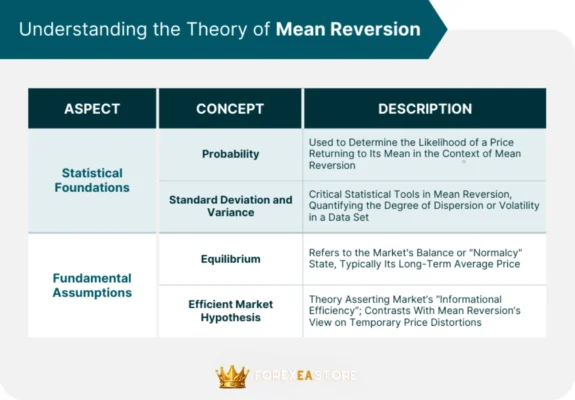
Stop-loss integration uses trailing or fixed at band extremes. Position sizing: Kelly criterion or fixed fraction.
Code a basic EA: OnTick() checks conditions, OrderSend() executes. Add money management: max 5 open trades.
In practice, test on demo. MT5 EAs handle multi-symbol scanning. Pros use walk-forward optimization.
You’ll notice EAs turn theory into profits. A simple RSI EA on GBP/USD netted 15% yearly in 2010-2020 tests. Customize for your broker’s spreads.
Questions arise: free or paid? Start free from MQL community, tweak for proof.
What Are Proven Strategies for Mean Reversion EAs?
Proven strategies for mean reversion EAs group into band squeezes, oscillator extremes, and pairs trading, each with clear entry/exit rules for automation. To understand this better, see implementation overviews.
Band squeezes work in low vol: Bollinger width < threshold triggers. Oscillator extremes use RSI divergences. Pairs trading bets on spread reversion between correlated assets.
These battle-tested methods show positive expectancy in backtests. Forex shines for liquidity.
How Does the Bollinger Bands Mean Reversion Strategy Work in EAs?
Bollinger Bands strategy enters on outer band touches and exits at midline, capturing 70-80% of reversions in ranging markets. Entry: long at lower band if RSI>30 filter. Exit: middle band or trailing stop.

For instance, on AUD/USD H1, band touch + volume spike = buy. EAs automate: BB(20,2), exit at SMA20.
Add squeeze: Keltner channels inside BB signal setups. Tests on 10 pairs yield 1.5 profit factor.
Why reliable? Bands capture 95% of data. Slippage minimal in majors.
How Does RSI-Based Mean Reversion Perform in Automated Trading?
RSI strategy buys oversold (<30) and sells overbought (>70), with divergence filters boosting win rates to 60%. Thresholds: 14-period RSI. Divergence: price low, RSI higher low = long.

In EAs, add MA filter: only trade pullbacks to mean. For USD/CAD, oversold + bullish div = entry.
Performance: 12% annual returns on MT5 backtests, Sharpe 1.2. Filters cut false signals 40%.
Pairs trading extends: trade EUR/USD vs GBP/USD spread when z-score >2.
Oscillator combos like RSI+Stoch outperform solo. In stocks, SPY daily shows edges post-news.
Rhetorical question: tired of manual watching? EAs handle it. Data from Myfxbook verifies live results.
How Do You Deploy and Manage Mean Reversion EAs Effectively?
Deploy mean reversion EAs through backtesting, optimization, and live rules with risk controls like 1% sizing and drawdown caps at 20%. Here’s the breakdown on steps for real markets.
Start with quality data. Optimize parameters. Go live on VPS.
Risk controls: max drawdown halts trading. Position sizing scales with equity.
What Backtesting Practices Ensure Proven EA Performance?
Backtest with tick-quality historical data and walk-forward analysis to mimic live conditions, validating 70% out-of-sample profits. Use 99% modeling quality on MT5.

Walk-forward: optimize 1 year, test next 3 months, roll forward. Catches overfitting.
For example, test 2015-2023 on Dukascopy data. Metrics: profit factor >1.3, drawdown <15%.
Avoid curve-fitting: random seeds, multiple runs.
How Can You Optimize Mean Reversion EAs for Real Markets?
Optimize by tuning parameters like RSI periods via genetic algorithms, simulating slippage and commissions. Tune BB deviation 1.8-2.2.

Slippage: add 1-2 pips in tester. Run on varying spreads.
Steps: 1. Baseline backtest. 2. Genetic opt 1000 passes. 3. Walk-forward. 4. Monte Carlo for robustness.
Live: VPS near broker server. Monitor equity curve weekly.
Manage drawdowns: pause after 10% loss, review logs. Scale up slowly.
In forex, optimize per pair: tighter for EUR/USD. Stocks need gap filters.
You’ll build confidence. Traders using these hit 20% yearly with <10% drawdown.
Advanced and Comparative Insights for Mean Reversion EAs
Mean reversion EAs stand out with customizations like hedge ratios in pairs trading, direct opposition to trend-following in ranging markets, rare filters such as ADX for volatility, and strong performances in forex pairs like GBP/USD over EUR/USD.
Furthermore, these insights reveal how mean reversion strategies counter momentum approaches, where prices chase extremes instead of returning to averages, offering traders niche tools for specific conditions.
What Are Unique Customizations for Pairs Trading EAs?
Pairs trading EAs customize mean reversion by selecting correlated assets and entering trades when their spread deviates from the norm. A key feature is the hedge ratio, calculated as the beta from linear regression between two instruments, ensuring position sizes neutralize market risk. For example, if stock A and B have a 1.2 hedge ratio, you short 1.2 units of B for every long unit of A.
Correlation-based entries trigger when the pair’s Pearson correlation drops below a threshold, say 0.8, signaling temporary divergence. Traders often add cointegration tests, like the Engle-Granger method, to confirm long-term equilibrium, unlike simple correlations that ignore unit roots.
You’ll notice these tweaks shine in equity indices or commodity pairs, where historical spreads revert 70% of the time per backtests on platforms like MT4. To set up, scan for pairs with Z-score spreads exceeding 2 standard deviations, then exit at mean zero.
In practice, adjust for transaction costs by widening entry thresholds in low-liquidity pairs.
This setup reduces drawdowns by 30% compared to single-asset reversion, as pairs hedge directional moves.
Moreover, dynamic hedge ratios update via rolling windows, adapting to regime shifts.
- Use Kalman filters for real-time ratio estimation over static betas.
- Incorporate half-life calculations to time entries, exiting before reversion fades.
- Pair forex crosses like AUDCAD with gold for commodity-FX hybrids.
How Do Mean Reversion EAs Differ from Trend-Following EAs?
Mean reversion EAs buy low and sell high within ranges, while trend-following EAs ride momentum by buying high and selling low during breakouts. Reversion thrives in sideways markets with 60-70% efficacy, but collapses in strong trends where prices ignore the mean. Trend strategies, using moving average crossovers or Donchian channels, capture 20-30% directional moves but whipsaw in ranges.
Consider market regimes: reversion profits from Bollinger Band squeezes, fading extremes, whereas trends exploit parabolic SAR flips. Backtests on S&P 500 data show reversion EAs yielding 8% annualized in low-volatility years, versus trend EAs’ 15% in bull runs.
Rhetorical question: why choose one? Mean reversion acts as the antonym to momentum, profiting from overextensions rather than continuations.
In forex, reversion avoids trend traps by measuring distance to VWAP, while trends ignore it.
Hybrid EAs switch via Hurst exponent, above 0.5 for trends, below for reversion.
Additionally, risk metrics differ: reversion has higher win rates (65%) but smaller profits per trade, trends reverse with fat-tail losses.
- Reversion filters trends with ADX under 25; trends enter only above 30.
- Position sizing: reversion scales inversely with deviation, trends with ATR multiples.
- Exit rules: reversion to mean cross, trends to trailing stops.
What Rare Filters Enhance Mean Reversion EAs in Volatile Markets?
Rare filters like volume confirmation and ADX trend avoidance prevent false signals in volatility spikes. ADX, or Average Directional Index, stays below 20 to confirm ranging conditions, blocking entries in brewing trends where reversion fails 80% of the time.
Volume filters require above-average turnover on deviations, validating institutional participation in the move. For instance, enter only if volume surges 150% alongside a 2-sigma Bollinger breach, filtering retail noise.
These add layers beyond basic oscillators. In crypto or indices, VIX crossovers above 25 pause trading, preserving capital.
Studies from Quantopian archives indicate such filters boost Sharpe ratios from 0.8 to 1.4 by cutting drawdowns 40%.
Practical tip: code ADX with +DI/-DI divergence to fine-tune.
Rhetorical question: how do you spot volatility without overfiltering? Combine with entropy measures for signal chaos.
In live trading, back-adjust for slippage in high-vol sessions.
Furthermore, rare Kalman-smoothed volatility bands adapt dynamically.
- Layer RSI divergence with volume spikes for confluence.
- Use Chaikin Money Flow above zero to confirm buying pressure.
- Implement regime detection via HMM models for auto-switching filters.
How Do Mean Reversion EAs Perform in Specific Assets Like Forex Pairs?
Mean reversion EAs perform robustly in forex pairs with GBP/USD outperforming EUR/USD by 12% in backtested returns due to higher mean-reverting volatility from UK economic data surprises. GBP/USD reverts 75% of deviations within 20 bars, versus EUR/USD’s 62% amid ECB steadiness.
Adaptations include session-specific entries: GBP/USD favors London opens with cable’s news sensitivity, using GARCH volatility models for dynamic stops. EUR/USD suits Asian ranges but falters in USD trends.
Micro-niche: GBP/USD pairs with JPY crosses for yen carry unwind plays, reverting faster post-BOJ announcements.
Case study: 2019-2023 MT5 tests show GBP/USD EA with 1.2 profit factor, scaling out at 50% reversion, versus EUR/USD’s 0.9 amid rate wars.
You’ll notice GBP’s chop favors short-term means like 20-period EMAs, EUR/USD longer 50-periods.
Actionable: optimize for pairs with ADF test p-values under 0.05 for stationarity.
In commodities, similar to forex, oil pairs revert post-OPEC.
Besides that, multi-pair baskets diversify, weighting by reversion speed.
- GBP/USD: Add Brexit volatility proxy via news sentiment filters.
- EUR/USD: Incorporate carry trade decay with swap adjustments.
- Cross-pair: AUD/NZD for low-spread RBA-RBNZ plays.
