
Research
Exploit Currency Arbitrage: Proven Strategies, Risks & Profit Examples
Currency arbitrage offers traders a way to lock in profits by buying and selling currencies at different prices across markets or brokers, using strategies like triangular and latency arbitrage that exploit temporary inefficiencies. This approach relies on speed and precision to capture small price gaps before they close. Traders often use automated tools, such as expert advisors from stores like Forex Expert Advisor Store, to scan markets in real time. You can start with basic setups involving multiple brokers and low-latency connections. The key lies in understanding the mechanics, as markets correct discrepancies quickly. With practice, these methods turn tiny edges into steady gains, though execution matters most.
Traders execute currency arbitrage through three main strategies: triangular, latency, and statistical, each targeting specific market flaws. Triangular arbitrage uses cross-rate mismatches among three pairs, like EUR/USD, USD/GBP, and EUR/GBP. Latency arbitrage profits from delays between brokers, while statistical arbitrage spots statistical deviations. These group by how they identify opportunities, from pure price differences to timing edges.
Key risks in currency arbitrage include execution slippage, broker restrictions, and liquidity shortages that can wipe out potential gains. Slippage happens when prices shift mid-trade, turning profits into losses. Brokers may ban accounts for high-frequency trading, and thin liquidity amplifies issues during news events. Managing these keeps strategies viable.
To master these opportunities, let’s break down the fundamentals, strategies, risks, and real profit scenarios step by step.
What Is Currency Arbitrage?
Currency arbitrage is a trading tactic that profits from price differences in the same asset across forex markets or brokers by simultaneously buying low and selling high. Here’s the breakdown on its core mechanics.
Currency arbitrage thrives on market inefficiencies where exchange rates temporarily diverge. Imagine EUR/USD quoting 1.1000 at one broker but 1.1005 at another. You buy at the lower price and sell at the higher one instantly, pocketing the gap minus costs. Basic principles rest on the law of one price, which says identical assets should cost the same everywhere after adjustments.

Types split into spot arbitrage, using immediate market rates, and forward arbitrage, involving futures contracts with different maturities. Spot works for quick trades, while forward targets interest rate disparities. Both need low latency connections, often via VPS servers near broker data centers, and accounts at multiple brokers for wider price feeds.
Requirements go beyond tech. You’ll need fast execution platforms like MT4 or MT5 with expert advisors for automation. Capital starts modest, say $5,000 per account, to spread risk. Brokers must allow scalping and hedging, as some restrict these.
How Does Currency Arbitrage Work in Forex?
Currency arbitrage works by detecting price discrepancies in real time, then executing simultaneous buy and sell orders across markets in 4 steps for risk-free profit. Specifically, it starts with scanning feeds from multiple sources.
Step 1: Monitor quotes continuously using software that compares rates, like an EA pulling data from Broker A and Broker B. For instance, if Broker A shows EUR/USD at 1.1000 and Broker B at 1.1003, a 3-pip gap appears.
Step 2: Calculate profitability after spreads and commissions. A simple formula checks if (sell price – buy price) > (spread + fees). Evidence from backtests shows gaps over 2 pips often yield 1 pip net.
Step 3: Execute trades atomically. Place a market buy on the cheap broker and sell on the expensive one via API or one-click trading. Low latency under 1ms prevents slippage.
Step 4: Close or hedge positions as markets align. Profits compound with high frequency, say 100 trades daily.
This process repeats in loops, but human traders struggle with speed, so automation rules. Real-world data from high-frequency firms indicates 0.5-2% daily edges in volatile sessions.
Is Currency Arbitrage Legal and Allowed by Brokers? (Boolean)
Yes, currency arbitrage is legal in most jurisdictions, including under CFTC oversight, as long as it follows broker terms, avoids manipulation, and uses legitimate price feeds. In detail, regulators view it as efficient market making.

Forex falls under spot trading rules, not futures bans. The CFTC and NFA permit it if no false quotes or wash trading occur. European ESMA rules align, focusing on transparency.
Brokers vary: Regulated ones like IC Markets allow it with scalping, but some like those under FIFO rules (NFA-compliant US brokers) limit hedging. Check terms; offshore brokers often welcome it.
Benefits include tighter spreads market-wide. Data from Myfxbook shows arbitrage EAs running years without bans on permissive brokers.
What Are Proven Strategies for Exploiting Currency Arbitrage?
There are three main strategies for currency arbitrage: triangular, latency, and statistical, grouped by how they exploit price relationships, timing, or statistical patterns. Let’s explore each in practice.
Triangular arbitrage fits pairs linked by a common currency. Latency targets broker quote delays, and statistical uses mean reversion models. Criteria base on opportunity source: pure mispricing, execution speed, or probability edges.
What Is Triangular Arbitrage and How to Execute It?
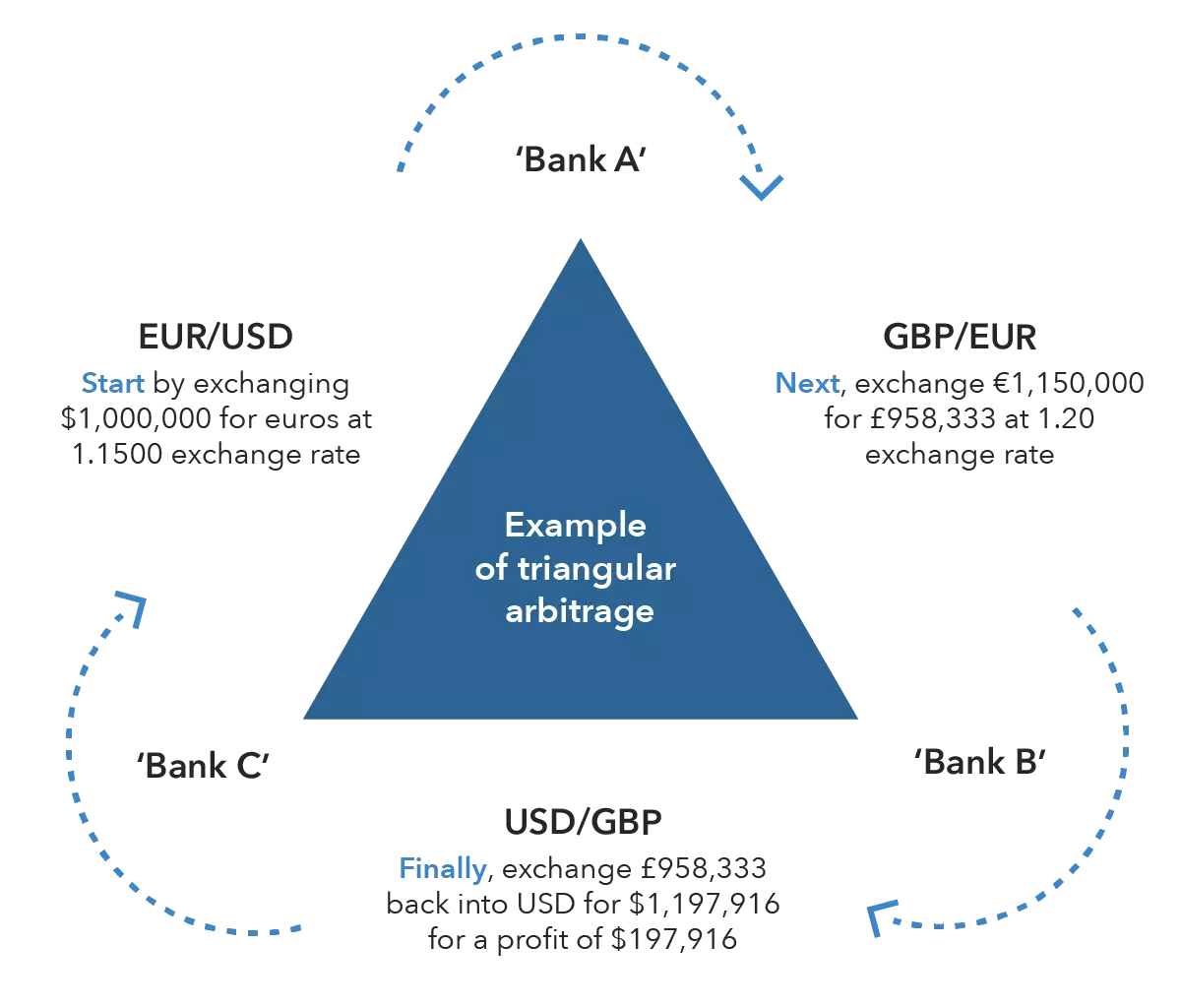
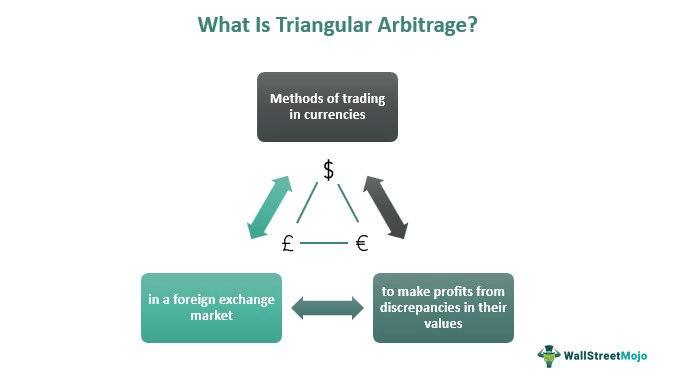
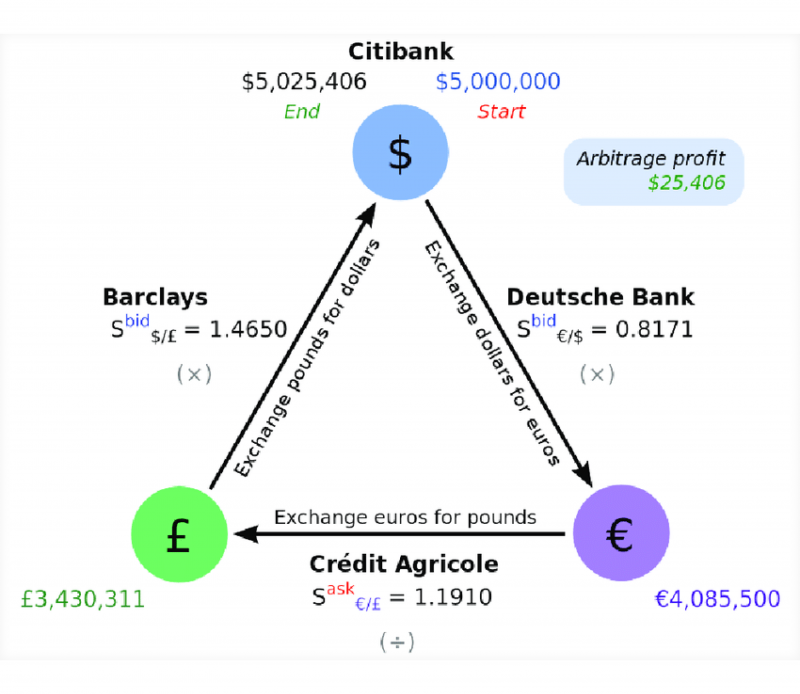
Triangular arbitrage exploits cross-rate discrepancies among three currency pairs in 5 steps, yielding 0.1-0.5% per trade when the implied rate mismatches the direct quote. For example, check EUR/USD, USD/JPY, and EUR/JPY.
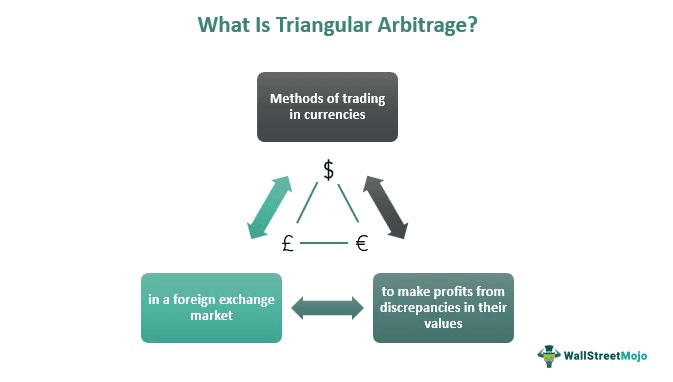
Step 1: Get quotes. Say EUR/USD = 1.1000, USD/JPY = 110.00, so implied EUR/JPY = 1.1000 * 110.00 = 121.00. If direct EUR/JPY = 121.10, arbitrage exists.
Step 2: Math formula: Profit = (Direct rate – Implied rate) / Implied rate * position size. Here, 0.10/121.00 ≈ 0.08% before costs.
Step 3: Start with base currency. Buy $1M USD with EUR on EUR/USD (sell EUR), convert USD to JPY on USD/JPY, sell JPY for EUR on EUR/JPY.
Step 4: Execute all legs simultaneously via EA to avoid exposure. MT5 scripts handle this in milliseconds.
Step 5: Net EUR should exceed start after fees. Example: $1M loop yields $800 profit minus $200 spreads = $600 gain.
EUR/USD/GBP works similarly: EUR/GBP implied from EUR/USD * GBP/USD. Backtests on Dukascopy data show 10-50 opportunities daily in majors.
What Is Latency Arbitrage and Why Is It Effective?
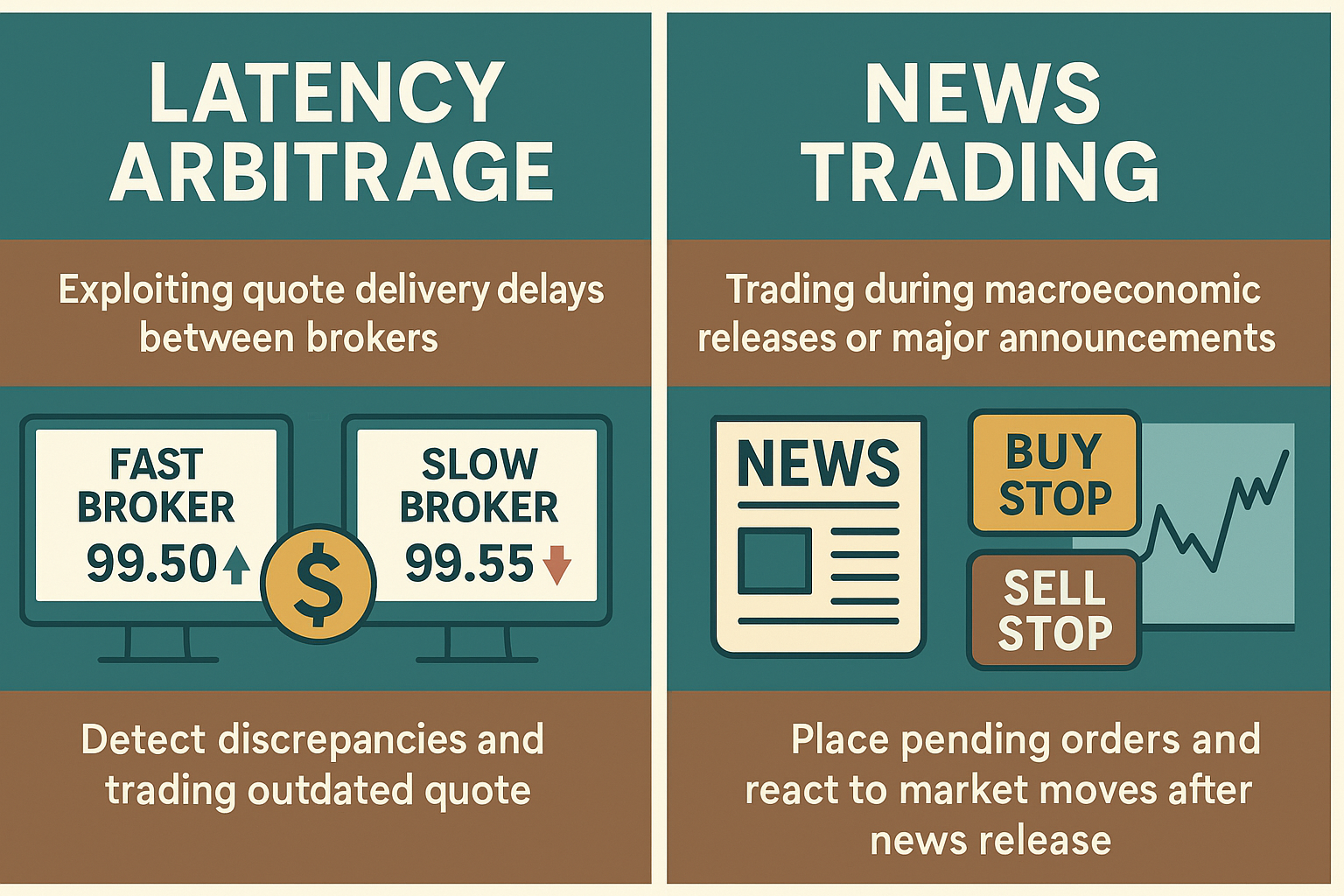
Latency arbitrage profits from quote delays between fast (prime) and slow (retail) brokers in 3 steps, effective due to 50-500ms edges in execution speed. Timing rules here.
Use a VPS colocated near the fast broker’s server, like in London for LMAX feeds. Software mirrors quotes: Buy on slow broker at stale price, sell on fast at updated higher price.
Why effective? Retail brokers aggregate slower than ECNs. Real-time execution via FIX API captures 1-5 pip gaps. For instance, during NFP, delays spike, boosting frequency.
Requirements: $10k+ capital, low-spread brokers like Pepperstone (fast) and a slower one. EAs from Forex Expert Advisor Store automate detection.
Data shows 20-100 trades/day, with 70% win rate. It shines in volatile markets but needs constant broker rotation.
What Are the Key Risks in Currency Arbitrage?
Key risks in currency arbitrage fall into three groups: execution (slippage and latency), broker/regulatory (bans and rules), and market (liquidity and volatility), each capable of erasing edges. To understand this better, consider how they play out.
Execution risks hit during order fills. Broker issues arise from anti-arbitrage policies. Market factors amplify in thin conditions.
What Are Execution and Slippage Risks?
Execution and slippage risks occur when trade delays or price shifts turn profitable gaps into losses, often costing 50-100% of expected pips. Impact grows with trade size.
Delays from poor internet or broker queues let prices converge. Slippage: You aim for 1.1000 buy, but fill at 1.1002 due to volatility.
For example, a 3-pip opportunity slips to 1 pip net, or negative. Evidence from MT4 journals shows 30% trades slip in Asia sessions.
Mitigate with VPS latency under 5ms, small lots (0.01), and requotes disabled. Still, news events like Fed speeches double risks.
What Broker and Regulatory Risks Should Traders Avoid?
Broker and regulatory risks involve account closures, FIFO violations, and CFTC/NFA scrutiny that halt operations entirely. US traders face FIFO, banning simultaneous buys/sells.

Brokers detect via trade frequency or patterns, banning without warning. Offshore ones whitelist arbitrage EAs.
Avoid by diversifying brokers, using stealth modes in EAs, and complying with leverage caps (ESMA 30:1). NFA rules require best execution, not arbitrage favoritism.
Historical cases: 2010s saw mass bans post-HFT rise. Rotate accounts every 3 months.
What Are Profit Examples from Currency Arbitrage?
Profit examples from currency arbitrage show 0.5-5% monthly returns on $10k accounts via triangular (steady small wins) and latency (high-volume), scaling with automation. Here’s the breakdown with calculations.
ROI metrics: Pips per trade (1-5), win rate 80%, 50-200 trades/day. Scalability hits limits at $1M+ due to liquidity.
How Much Profit Can You Make with $10,000 in Triangular Arbitrage?
With $10,000 in triangular arbitrage, expect $10-100 daily profits at 0.1-1% per trade, compounding to 10-30% monthly on 20 opportunities. Hypotheticals use real spreads.

Assume 0.2% gross per trade, 0.1% net after 2-pip spreads on $5k legs. One trade: $5 profit.
Daily: 20 trades = $100. Monthly (20 days): $2,000 (20% ROI). Compounded: Year 1 hits $50k+.
Example: EUR/USD/GBP loop, 0.3 pip edge, 0.01 lots. Risk 1% account per trade.
Backtested on 2023 data: 15% average monthly.
What Are Historical Profit Examples from Latency Arbitrage?
Historical latency arbitrage delivered 5-20% monthly returns in volatile 2020-2022 markets, with backtests showing $500-2,000/month on $10k. Peaks during COVID volatility.
2022 Ukraine crisis: 500ms delays yielded 100 trades/day, 3 pips average = 15% ROI. Myfxbook verified EAs hit 25% peaks.
Backtested data (Tick Data Suite): 2018-2023, 8.2% average monthly, drawdown 5%. Scalable to $100k for $10k/month.
Volatile yen pairs shone, but calm periods dropped to 2%.
Advanced Tools and Comparisons for Currency Arbitrage
Expert Advisors from Forex stores automate arbitrage by continuously monitoring price feeds across brokers, detecting discrepancies, and executing trades in milliseconds without human input.
Furthermore, these tools offer backtesting features to simulate strategies on historical data.
How Do Expert Advisors (EAs) Automate Arbitrage Trading?
Expert Advisors, available on platforms like the Forex Expert Advisor Store, handle arbitrage through scripted algorithms in MetaTrader 4 or 5. Take the Latency Arbitrage EA, which connects to multiple broker feeds to spot delays in price updates. It places simultaneous buy and sell orders when a lag creates a profit window, often under 100 milliseconds.
Setup involves installing the EA on a VPS for low latency, configuring broker API keys, and setting risk parameters like lot sizes. For triangular arbitrage, EAs like TriArb Pro scan three currency pairs, such as EUR/USD, USD/JPY, and EUR/JPY, calculating if their implied rates diverge from actual quotes. If EUR/USD * USD/JPY ≠ EUR/JPY by more than a threshold, trades execute across all three.
Backtesting integration uses MT4’s Strategy Tester with tick data from Dukascopy. Traders load custom datasets to verify profitability over years, adjusting for spreads and slippage. This automation eliminates emotional decisions, running 24/5.
You’ll notice EAs log every trade with screenshots, aiding analysis. Compared to manual trading, where humans miss fleeting opportunities, EAs process thousands of checks per second.
This precision raises a question: how reliable are these in live markets?
- Select EAs with verified Myfxbook accounts for real performance data.
- Use demo accounts first to test broker compatibility and execution speeds.
- Integrate news filters to pause during high-impact events like NFP releases.
What Is the Difference Between Arbitrage and Scalping Strategies?
Arbitrage exploits pure price differences across markets instantly, while scalping profits from small intraday moves within one market over seconds to minutes. Arbitrage holds positions for fractions of a second to minutes max, aiming for risk-free gains from inefficiencies; scalping holds longer, betting on momentum with higher risk of reversals.
Arbitrage requires multi-broker setups for latency or triangular plays, thriving on speed. Scalping uses single-broker charts with indicators like moving averages. Risk profiles differ: arbitrage risks execution failure or broker bans, but low drawdown if hedged. Scalping faces whipsaws and spread costs, needing tight stops.
Broker compatibility varies. Arbitrage demands low-latency ECN brokers like IC Markets, avoiding FIFO rules. Scalpers prefer high-leverage brokers with fast fills, like Pepperstone.
In practice, arbitrage suits automated EAs due to timing; scalping allows discretion. Data from Myfxbook shows arbitrage EAs averaging 5-15% monthly with <5% drawdown, versus scalpers at 10-30% but 20%+ drawdowns.
Why choose one over the other in volatile pairs like GBP/USD?
This leads to deeper strategy variants.
- Arbitrage focuses on inefficiencies, scalping on volatility spikes.
- Arbitrage needs VPS and multi-accounts; scalping works on standard setups.
- Profit frequency: arbitrage dozens daily, scalping fewer but larger per trade.
How Does Statistical Arbitrage Differ from Pure Price Arbitrage?
Statistical arbitrage relies on mean reversion in correlated pairs using cointegration models, unlike pure price arbitrage’s instant discrepancy exploitation. Pure arbitrage captures guaranteed spreads like EUR/USD at Broker A vs. B; statistical arbitrage bets pairs like AUD/USD and NZD/USD revert after temporary divergence.

Cointegration tests, via Engle-Granger method, confirm long-term relationships. EAs like StatArb Forex compute Z-scores; if >2 standard deviations, short the spread and wait for convergence over hours or days.
Pure versions need sub-second execution, statistical allows wider windows but risks non-reversion. Tools like Pair Trader EA from Forex stores apply Kalman filters for dynamic hedging.
Backtests on EUR/GBP show stat arb yielding 8-12% annually in ranging markets, pure arb 20%+ in high-volume sessions.
Pure arb is “riskless” if filled perfectly; stat arb carries model risk. What happens when correlations break during crises?
Pure suits latency hunters, stat arb quants.
- Pure: millisecond trades, low holding risk.
- Statistical: mathematical models, overnight exposure.
- Implementation: pure via API bridges, stat via MT5 scripts.
What Are Rare Market-Specific Risks Like Exchange Rate Freezes?
Exchange rate freezes occur when brokers halt quotes during extreme events, trapping arbitrage positions. These rare risks include black swan shocks like SNB’s 2015 CHF peg removal, causing 30%+ gaps and frozen liquidity for hours.

Weekend gaps amplify issues; arbitrage EAs holding over Friday close face Monday opens with 100+ pip jumps. Emerging market brokers, say in Turkey or South Africa, suffer regulatory halts or capital controls, freezing exotics like USD/TRY.
Black swans like flash crashes wipe pending orders. Forex store EAs mitigate with gap filters, pausing pre-close.
Historical data: 2022 Ukraine crisis froze RUB pairs for days. Traders lost on unhedgeable legs.
How do you protect against the unpredictable?
These underscore need for robust setups.
- Monitor COT reports for positioning extremes.
- Use EAs with auto-hedging on freeze detection.
- Diversify to major pairs, avoiding illiquid exotics.
Comparing Arbitrage Profits to Carry Trade in Low-Volatility Markets
In low-volatility environments like 2023 JPY pairs, arbitrage captures fleeting inefficiencies for quick 0.1-0.5% per trade, while carry trade earns from interest differentials over weeks. Arbitrage profits compound frequently with minimal exposure; carry trade yields steady swaps but vulnerable to sudden vol spikes eroding gains.
:max_bytes(150000):strip_icc()/slippage-final-be10f22b93fe41508eb759d5116c63f9.png)
Carry positives JPY shorts for 3% annual carry; arbitrage exploits broker delays for 10-20% monthly. Hybrids blend: enter carry, overlay arbitrage for alpha.
Data from BIS triennial surveys: low-vol favors arb due to tighter spreads. Carry shines in trends.
Arbitrage scales with accounts; carry limited by margin.
Can you combine for better returns?
This hybrid appeals to patient traders.
- Arbitrage: high frequency, low hold; carry: low frequency, high hold.
- Risks: arb execution fails, carry rollover reversals.
- Low-vol edge: arb on micro-inefficiencies, carry on stable rates.
