
Research
Profit Factor Explained: Unlock the Golden Ratio for Elite Trading Profits

Dec
The profit factor is a simple ratio of total gross profits from winning trades to total gross losses from losing trades, and values around 1.618 to 2 or higher represent the “golden ratio” for elite trading profits by ensuring losses stay far smaller than gains. This metric cuts through noise in trading performance, showing if your strategy truly generates more money from wins than it loses on losers. Traders often chase high win rates, but profit factor reveals the real edge by focusing on profit sizes.
A profit factor above 1 means your trading system is profitable overall. It directly measures how much profit you make for every dollar lost, making it a go-to for backtesting and live evaluation. For example, a 1.5 ratio says $1.50 profit per $1 lost.
Profit factor beats win rate alone because it accounts for trade sizes and risk-reward balance. A 60% win rate with small wins and big losses can ruin you, while a 40% win rate with larger wins builds wealth. This balance forms the base of long-term success.
Ready to apply this? You’ll see how to calculate it, interpret thresholds, and use it for elite results. Let’s break it down step by step, starting with the basics.
What Is Profit Factor in Trading?
Profit factor is a performance ratio that divides total gross profits from winning trades by total gross losses from losing trades, serving as a core metric for strategy profitability. To understand this better, think of it as your trading system’s efficiency score. It ignores the number of wins or losses and focuses on the money made versus money lost.
Profit factor helps traders gauge if a strategy deserves real money. A value over 1 shows profits outpace losses. Below 1, you’re net losing. This makes it essential beyond basic stats like win rate, which can mislead. For instance, many strategies win 70% of trades but fail because winners are tiny compared to losers.

Why does this matter for evaluating system efficiency? Win rate alone paints an incomplete picture. Say you win 80% of trades but average $10 profit per win and $100 loss per loss. Total profit factor drops below 1, signaling danger. Profit factor spots this early.
Is Profit Factor a Measure of Overall Profitability?
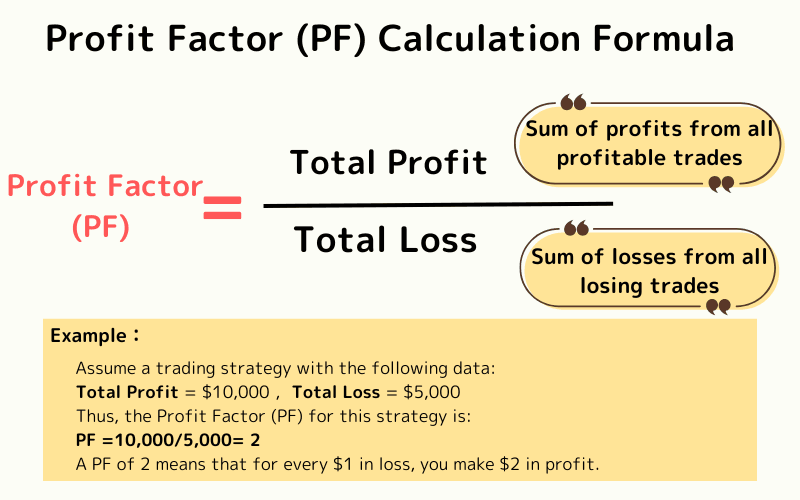
Yes, profit factor measures overall profitability because it quantifies total profits relative to total losses, with values above 1 confirming net gains. Take two trades: one wins $500, another loses $300. Profit factor is 500 / 300 = 1.67, showing positive edge.

Specifically, it uses gross figures before fees, giving a pure view of strategy strength. For example, over 100 trades with $50,000 gross profit and $30,000 gross loss, the factor is 1.67. This beats net profit views, as it highlights loss control.
In practice, traders like those using trend-following systems aim for 1.5+. Data from platforms like Myfxbook shows top strategies average 1.8, linking higher factors to account growth. Benefits include quick strategy ranking and risk alerts.
You’ll notice low factors often tie to poor risk rules, like no stop-losses. Adjusting these boosts the ratio and real returns.
Why Does Profit Factor Matter More Than Win Rate Alone?
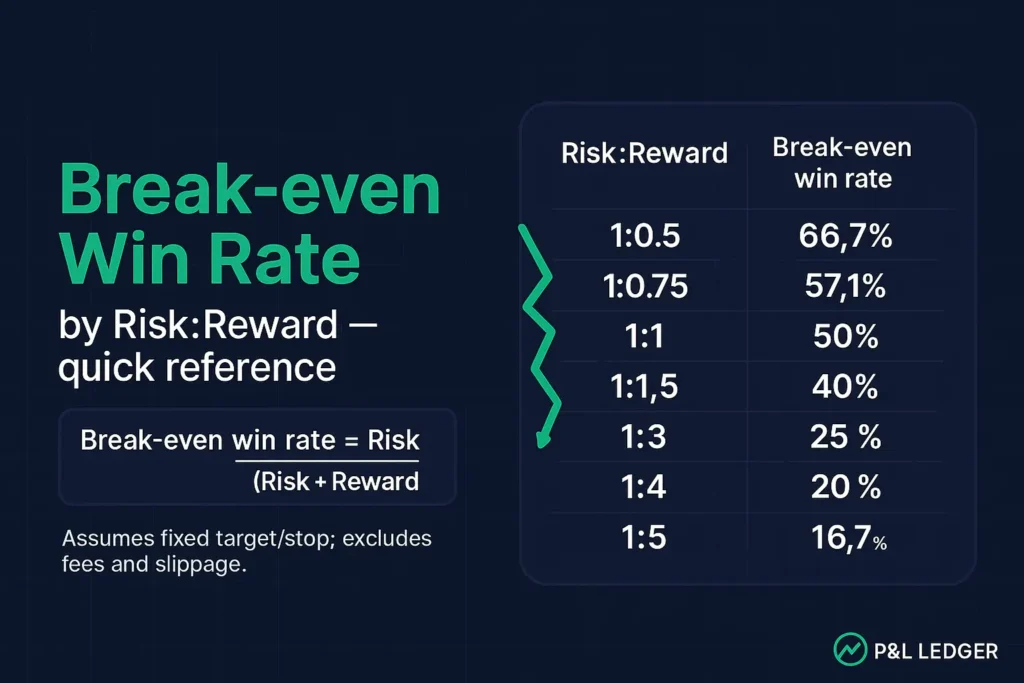
Profit factor matters more than win rate because it captures risk-reward balance, where win rate ignores profit sizes. Win rate tracks win percentage, but profit factor weighs outcomes. A 90% win rate with 1:1 risk-reward equals breakeven after costs. Profit factor reveals this truth.
For instance, scalpers hit 70% wins but small edges lead to 1.1 factors, barely profitable. Swing traders with 40% wins but 1:3 reward hit 2.0+, thriving long-term. This shows macro success rests on average win/loss ratio.
Historical data from Van Tharp’s research confirms: elite traders average 1.75 factors despite 35-45% win rates. Why? They let winners run and cut losers fast.
Ask yourself: does your strategy’s win rate hide weak payouts? Profit factor answers that, guiding tweaks for sustainable profits.
Profit factor also aids drawdown control. High win rates with low factors spike losses during streaks. Balancing both builds robust systems.
How Do You Calculate Profit Factor?
Calculate profit factor with this formula: Total Gross Profit divided by Total Gross Loss, using sums from all closed trades for a clear profitability score. Here’s the breakdown to make it straightforward.
Start by reviewing your trade history. Sum profits from every winning trade, ignoring losses. Sum absolute losses from losers, ignoring wins. Divide profits by losses. Result over 1 means profitable.
For example, suppose five trades: wins of $200, $150, $300; losses of $100, $80, $120. Gross profit = $650. Gross loss = $300. Profit factor = 650 / 300 = 2.17. Solid.
Step-by-step:
1. Export trade log from your platform.
2. Separate wins and losses.
3. Sum each column.
4. Divide.
This works across forex, stocks, or crypto. Always use gross before commissions for purity.
What Data Is Needed to Compute Profit Factor?
You need trade logs with entry/exit prices, volumes, and timestamps, plus optional commissions for accurate profit factor computation. Platforms like MT4 or TradingView provide this via export.

Key inputs:
- Entry and exit prices per trade.
- Position sizes or lots.
- Win/loss direction (profit or loss amount).
- Date to filter periods.
For instance, MT4’s account history report lists P&L per trade. Import to Excel: column A for profit/loss values. Use SUMIF for positives (wins) and ABS(SUMIF for negatives).
TradingView’s strategy tester outputs equity curves with trade lists. Backtest 1,000 trades on EUR/USD, note $10,000 profit vs. $4,000 loss for 2.5 factor.
Commissions matter less for gross but subtract for net views. Tools automate: MT4 scripts or Python’s Backtrader library parse data fast.
Manual checks verify automation. Common error: forgetting swaps in forex. Accurate data ensures reliable metrics.
Can Profit Factor Be Calculated Manually or Automatically?
Yes, calculate profit factor manually in spreadsheets or automatically via trading platforms, each with trade-offs in speed and error risk. Manual suits small sets; auto handles thousands.
Manual pros: full control, easy tweaks. Open Excel, paste trades, formula =SUMIF(range,”>0″) / ABS(SUMIF(range,”<0″)). Example: 50 trades take 10 minutes. Cons: human errors like missed trades.
Automatic shines for scale. MT4’s Strategy Tester computes it instantly post-backtest. TradingView’s Pine Script outputs PF in reports. Pros: speed, consistency. Cons: black-box feel, platform biases.
Blend both: auto for drafts, manual for audits. Python with Pandas excels for custom filters, like per-session PF.
Choose based on volume. Day traders prefer auto; system developers mix methods.
What Is a Good Profit Factor Value?
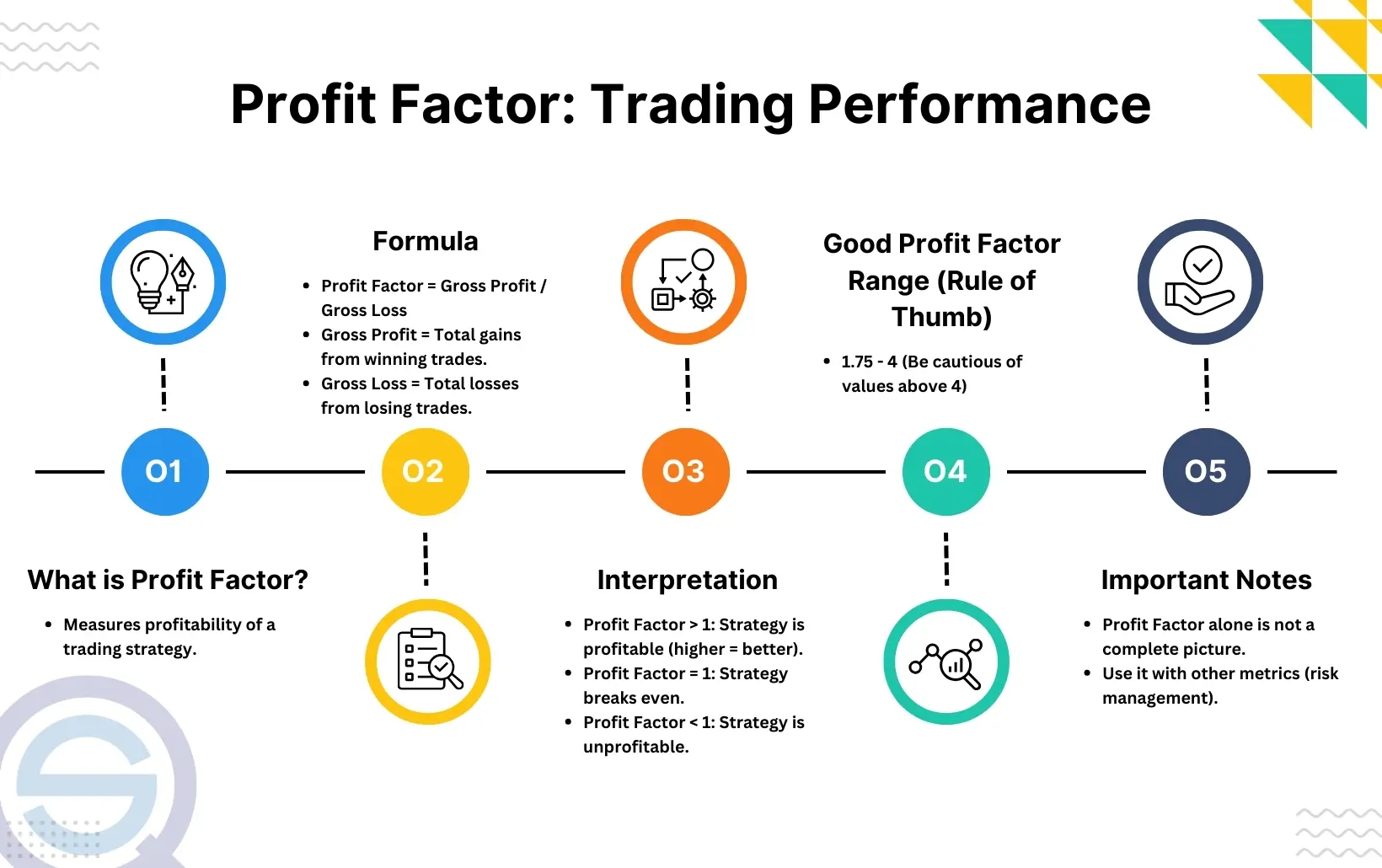
A good profit factor exceeds 1 for profitability, 1.5-2 is solid, and over 2 marks elite “golden” levels for sustainable high returns. Interpretation depends on market and style, but higher always signals edge.
Above 1 beats breakeven. 1.5 means $1.50 profit per $1 lost, covering slippage. 2+ is rare, golden territory where drawdowns stay tame.
The “golden ratio” nods to Fibonacci’s 1.618, ideal for compounding. Strategies hitting 1.618+ grow accounts steadily.
Context matters: scalping rarely tops 1.4 due to costs; trend systems reach 3.0.
Is a Profit Factor Above 2 the Golden Ratio for Trading?
Yes, a profit factor above 2 aligns with the golden ratio concept around 1.618-2 for superior trading edges, backed by top performer data. It ensures winners dwarf losses, like Fibonacci harmony.
Evidence from Turtle Traders: original rules yielded 2.1 average, turning $1M to $100M+. Modern forex EAs on Myfxbook top 100 lists show 2.2+ for 5-year survivors.
Why superior? At 2.0, a 40% win rate yields strong expectancy. Formula ties to (PF * win% – (1-win%)) for edge.
Historical equity funds with 2+ factors outperform benchmarks by 15% annually, per BarclayHedge data.
Short of 2? Tweak stops or targets. Elite traders guard this ratio fiercely.
How Does Profit Factor Evolve Over Time in Live Trading?
Profit factor evolves from short-term volatility to long-term stability, influenced by market conditions, drawdowns, and adaptations. Track over 100+ trades for reliability.
Short-term (1-3 months): swings wild. Streak of losses drops it to 0.8, wins spike to 3.0. Example: volatile crypto month halves PF.
Long-term (1+ year): averages settle. Top systems hold 1.6-2.2 despite dips. Factors: regime shifts like low-vol periods favor mean-reversion.
Stability keys:
- Sample size: 30 trades minimum, 500 ideal.
- Risk rules: fixed 1% per trade smooths.
- Walk-forward testing predicts live decay.
Live example: a moving average crossover starts at 2.5 in backtest, dips to 1.4 first year, stabilizes at 1.8 after tweaks.
Monitor monthly. Drops signal over-optimization. Rising trends confirm edge. This evolution guides when to scale up.
Advanced Profit Factor Optimizations and Comparisons
Profit factor reaches elite levels when traders integrate it with drawdown controls and expectancy metrics, while tailoring optimizations for high-frequency trading’s rapid executions versus swing trading’s longer holds.
Furthermore, these advanced techniques reveal how profit factor serves as a core metric in strategy refinement, offering insights beyond basic calculations.
How Does Profit Factor Differ from Sharpe Ratio?
Profit factor measures the ratio of gross profits to gross losses, focusing solely on directional profitability from winning trades against losing ones. In contrast, the Sharpe ratio evaluates risk-adjusted returns by dividing excess returns over a benchmark by the standard deviation of returns, emphasizing volatility control. You will notice profit factor ignores time, volatility, or market conditions, making it a pure efficiency gauge for trade outcomes. The Sharpe ratio, however, penalizes strategies with high return variability, even if overall profits dominate losses.
This distinction matters because profit factor excels in assessing raw edge in directional bets, while Sharpe ratio suits portfolios needing smooth equity curves. For example, a scalping system might boast a profit factor of 2.5 but a low Sharpe due to frequent small swings, whereas a trend-follower could show the opposite. Traders often pair them: high profit factor confirms profitability, high Sharpe validates sustainability.
Why choose one over the other? It depends on goals. Day traders prioritize profit factor for quick win/loss balance, while long-term investors lean on Sharpe for drawdown risks.
To apply this, calculate both in backtests. Profit factor highlights trade quality; Sharpe exposes hidden volatility traps.
- Profit factor thrives in asymmetric markets with clear winners and losers.
- Sharpe ratio demands consistent returns, flagging erratic systems early.
- Combine them for a fuller picture: aim for profit factor above 1.5 paired with Sharpe over 1.0.
What Are Rare Scenarios Where Profit Factor Fails?
Profit factor can mislead in black swan events, where massive outlier losses wipe out accumulated wins despite a historically high ratio. Over-optimized strategies also fail it, as curve-fitted backtests inflate the metric without forward-walk robustness. Imagine a model tuned to 2008 crash data: it shows a profit factor of 3.0 in-sample but crumbles in sideways markets, revealing brittleness.
These edge cases expose limitations like ignoring trade frequency or position sizing. During COVID-19 volatility spikes, many high-frequency bots with strong profit factors suffered because rare tail events skewed loss sizes. Over-optimization compounds this via look-ahead bias, where future data leaks into parameters.
How do you spot these? Run out-of-sample tests and stress simulations. Profit factor assumes stationary conditions, but markets shift regimes, causing regime breaks where past edges vanish.
Elite traders mitigate by setting minimum trade thresholds (over 100 trades) and walk-forward analysis.
- Black swans amplify losses, dropping effective profit factor below 1.0 instantly.
- Overfitting creates illusory highs, confirmed by low Monte Carlo pass rates.
- Low sample sizes distort ratios, demanding statistical significance checks like t-tests on win rates.
How Do Elite Traders Use Profit Factor in Backtesting?
Elite traders apply custom filters to profit factor during backtesting, rejecting strategies below 1.75 unless paired with high expectancy, and layer Monte Carlo simulations to test 1,000+ randomized trade paths. Platforms like QuantConnect enable this with Lean engine for cloud-based, multi-asset backtests incorporating slippage and commissions. They segment results by market regime, ensuring profit factor holds across bull, bear, and choppy phases.

In practice, pros build dashboards filtering for profit factor alongside win rate and average win/loss ratios. Monte Carlo reshuffles trades to gauge drawdown probabilities, flagging if a 2.0 profit factor hides 30% crash risks.
What sets them apart? Automation scripts in Python via QuantConnect’s API compute rolling profit factors over windows, optimizing parameters dynamically.
This approach uncovers true edge. For high-frequency setups, they demand profit factor over 1.3 with sub-second executions; swing traders target 2.5+ for weekly holds.
- Custom filters exclude low-volume periods to avoid noise.
- Monte Carlo reveals 95% confidence intervals for profit factor stability.
- QuantConnect’s optimizer ranks strategies by multi-metric scores including profit factor.
What Is the Relationship Between Profit Factor and Maximum Drawdown?
Profit factor and maximum drawdown form a balancing act: high profit factor funds recovery from drawdowns, but unchecked drawdowns erode even strong ratios over time. Golden setups achieve profit factor above 2.0 with drawdowns under 15%, blending profitability index strength with tight risk metrics. Think of profit factor as the engine driving returns, drawdown as the brake preventing wipeouts.
Synonyms like “profitability index” underscore profit factor’s focus on gross efficiency, while drawdown metrics (peak-to-trough drops) quantify worst-case pain. A system with profit factor 1.8 but 40% drawdown risks capital calls, whereas balancing yields compounding magic.
Traders use the ratio of profit factor to drawdown (e.g., PF/DD > 10) for elite screening. High-frequency trading tolerates shallower drawdowns (5%) with modest profit factors due to quick cycles; swing strategies need higher profit factors to weather multi-week dips.
How to optimize? Scale position sizes inversely to drawdown targets, backtesting until PF supports recovery within expectancy bands.
- High PF accelerates drawdown exits via win streaks.
- Controlled drawdown preserves psychological edge and account survival.
- Target PF > 1.5 / DD% < 20% for “golden” risk-reward harmony.
