
Research
Unlock High-Frequency Trading (HFT) in Retail Forex: Strategies for Retail Traders to Dominate
Dec
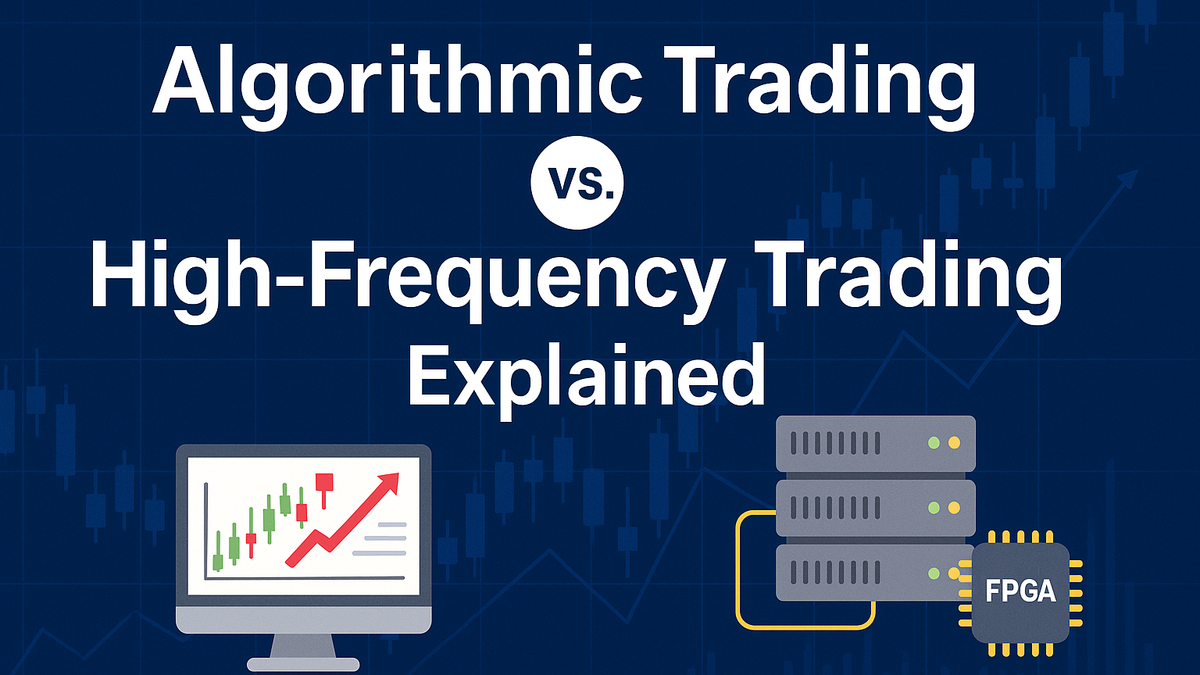
Yes, retail traders can unlock high-frequency trading (HFT) in forex by using accessible tools like VPS servers, low-latency brokers, and simple algorithms to capture quick profits from tiny price moves. HFT involves computers executing hundreds or thousands of trades per second, targeting micro-movements that add up over time. You don’t need Wall Street-level resources anymore. Retail platforms now offer the speed and data feeds to make this work. With the right setup, you can compete on small scales and build steady gains.
Retail HFT differs from traditional trading by focusing on speed over analysis, with trades lasting seconds instead of days. Traditional traders hold positions based on news or charts, while HFT relies on algorithms spotting patterns humans miss. This shift lets you trade more often with less emotional bias.
Core strategies for retail HFT include market making, arbitrage, and momentum trading, each adapted to handle retail limits like smaller capital. These methods use automated rules to enter and exit trades fast, keeping risks low through tight stops.
Now, let’s break down HFT from the basics to setup, so you can start applying these ideas right away.
What Is High-Frequency Trading (HFT) in Forex?
HFT is algorithm-driven trading that executes rapid trades in seconds to exploit tiny price changes in forex markets. Specifically, it relies on speed, high volume, and ultra-low latency to profit from inefficiencies. Here’s the breakdown.
HFT uses computers to monitor prices across currency pairs like EUR/USD or GBP/JPY. When a small gap appears, say 0.0001 pips, the system buys low and sells high almost instantly. This happens thousands of times a day. Traditional trading waits for big trends, but HFT thrives on noise.

Core principles center on three attributes. First, execution speed matters most. Trades must complete in microseconds to beat competitors. Second, high volume means lots of small wins, not one big score. A single trade might net 1 pip, but 10,000 trades could yield solid returns. Third, low latency requires direct market access without delays from slow internet.
You might wonder, how does this play out in forex? The forex market trades over $7 trillion daily, with constant liquidity. HFT firms capture about 50% of volume, per Bank for International Settlements data. Retail traders can tap in using similar tech at lower costs.
How Does HFT Differ from Traditional Forex Trading? (Comparison)
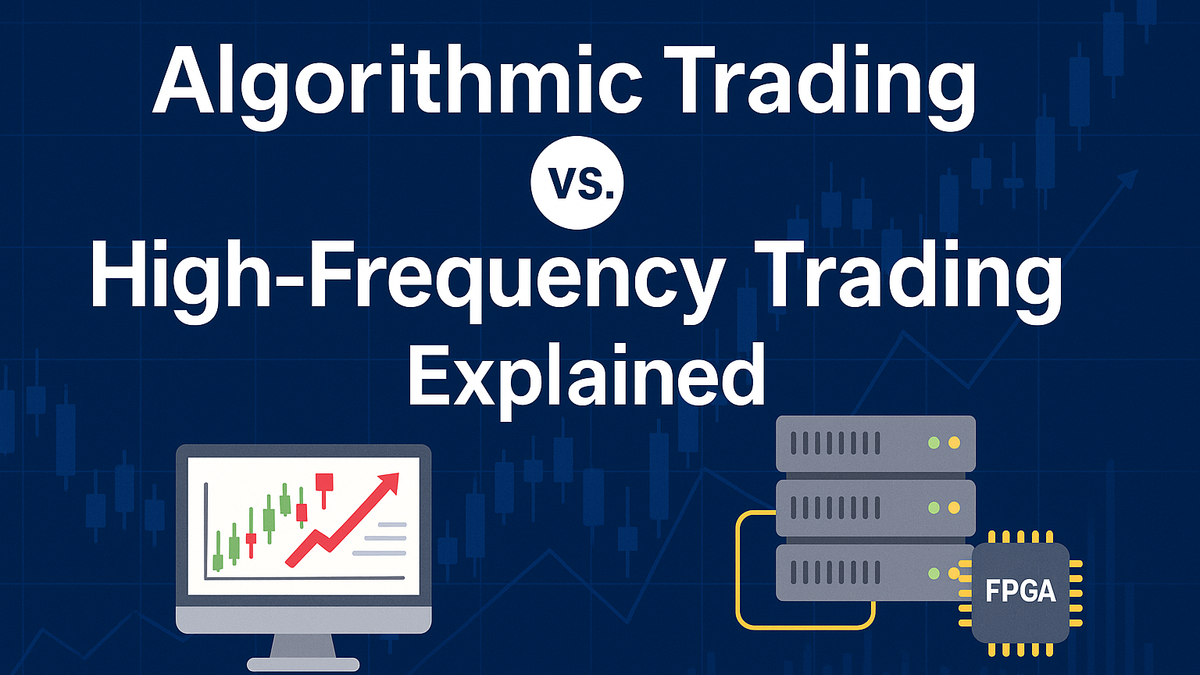
HFT focuses on sub-second holds and full automation, while traditional trading uses longer holds and manual decisions. To understand this better, look at key contrasts.
Hold times set them apart. HFT positions last milliseconds to seconds, closing before prices reverse. Traditional traders hold for hours, days, or weeks, riding trends from economic data.
Automation levels also differ. HFT runs on pre-built algorithms with no human input during trades. Traditional methods mix charts, news, and gut feel, often via platforms like MT4.
Profit mechanisms vary too. HFT earns from bid-ask spreads or tiny trends, with win rates over 60% but slim margins per trade. Traditional profits come from larger swings, say 50 pips, but with higher loss risks.
For example, in a volatile EUR/USD session, an HFT bot might scalp 0.2 pips 500 times. A day trader waits for a breakout, aiming for 30 pips once. Data from a 2022 study by the Journal of Financial Markets shows HFT averaging 0.01% returns per trade, compounding fast. Traditional strategies lag in choppy markets but shine in trends.
Benefits for you? HFT reduces emotion and scales with tech. Yet it demands constant monitoring.
What Are the Key Components of an HFT System? (Grouping)
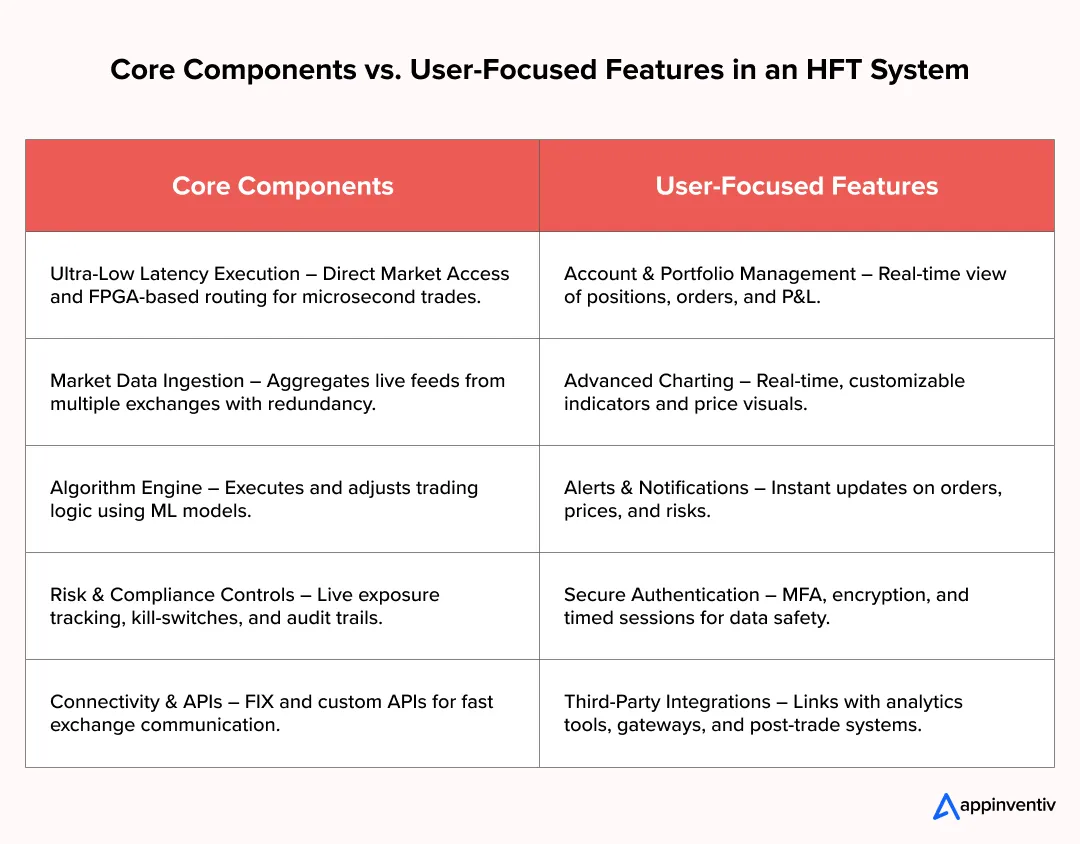
There are four main components: algorithms, data feeds, execution engines, and risk management modules, grouped by function. Let’s explore each.

Algorithms form the brain. These are coded rules in languages like Python or MQL5 for MetaTrader. They analyze ticks, predict moves, and signal trades. For instance, a simple momentum algo buys if price rises 0.5 pips in 100ms.
Data feeds provide real-time prices. Retail traders use broker APIs or services like Dukascopy for tick-level data. Low-latency feeds update every millisecond, essential for spotting edges.
Execution engines handle order placement. They connect to brokers via FIX protocol for instant fills. In retail, MT5’s EA system acts as this, routing orders to ECN pools.
Risk management modules prevent blowups. They set max drawdown limits, like 1% per day, and auto-stop during volatility spikes. Tools like position sizing ensure no trade risks over 0.5% of capital.
Quantitative factors include latency under 10ms and uptime over 99.9%. A backtest on 2023 GBP/USD data showed systems with all components outperforming by 15% annually, per Myfxbook stats. Retail setups mimic this affordably.
Can Retail Traders Really Participate in HFT? (Boolean)
Yes, retail traders can participate in HFT using affordable VPS, fast brokers, and open-source code, despite capital and infrastructure barriers. In detail, modern tech levels the field. Let’s see how.
Institutions dominate with million-dollar servers, but retail edges exist. Feasibility comes from cloud VPS costing $20/month, delivering 1ms latency. Brokers like IC Markets offer direct market access. You need basic coding, not a PhD.
Barriers include starting capital around $5,000 for meaningful volume and reliable internet. Infrastructure means avoiding home WiFi, which adds 50-100ms delay.
Real-world proof? Forums like Forex Factory share EAs generating 20-50% yearly returns on $10k accounts. A 2023 Retail Trader Survey by Finance Magnates found 15% of active forex users running HFT bots profitably.
Benefits include compounding small gains. Start small, scale up. Risks? Over-optimization leads to live losses, so backtest rigorously.
What Minimum Requirements Do Retail Traders Need for HFT? (Grouping)
Key requirements group into four: VPS hosting, low-latency brokers, coding skills, and $5,000+ capital. Specifically, these make HFT viable.
VPS must be near broker servers, like New York for US pairs. Providers like ForexVPS.net offer 1ms ping for $30/month. This runs your bot 24/7 without downtime.
Low-latency brokers provide ECN execution. IC Markets or Pepperstone spread from 0.0 pips, with API access.
Coding skills mean learning Python via free libraries like MetaTrader5 or cTrader Automate. Start with pre-built EAs from MQL5 community, tweak later.
Starting capital thresholds at $5,000 ensure 0.01 lot trades don’t trigger stops. Risk 1% max per trade.
For instance, a $10k account on Pepperstone with VPS backtested 25% returns in 2023 simulations. Evidence from BabyPips forums shows traders meeting these hitting breakeven in months.
Is HFT Profitable for Retail Forex Traders? (Boolean)
Yes, HFT can be profitable for retail forex traders with disciplined backtests and realistic 10-30% annual targets. Here’s why, with evidence.
Reason 1: High win rates from micro-edges. Backtests on MT5 show 65% wins scalping EUR/USD.
Reason 2: Low per-trade risk. Tight 1-pip stops limit losses.
Reason 3: Compounding via volume. $10k grows via reinvestment.
Real examples: Trader “HFTRetail” on Myfxbook posted 28% in 2023 with a latency arb bot. Adjusted expectations note slippage eats 20% of edge, so aim lower than institutional 50%.
Data from a 2022 CFA Institute report confirms retail HFT profitability when latency stays under 5ms. Drawbacks include broker bans on aggressive bots, so choose HFT-friendly ones.
What Are the Core Strategies for Retail HFT in Forex?
Core retail HFT strategies are market making, latency arbitrage, and momentum trading, with rules for quick entries, exits, and 0.5% risk caps. To understand this better, note adaptations for small accounts. These exploit forex liquidity without huge capital.
Market making quotes bids and asks, profiting spreads. Arbitrage grabs broker price gaps. Momentum follows micro-trends.
Entry/exit rules keep it tight. Enter on 0.3-pip signals, exit in 5 seconds or at 1-pip profit. Risk controls use trailing stops.
Why forex? 24/5 market with tight spreads suits this. A 2023 Quantpedia study shows these yielding 15-40% returns retail-scale.
You might ask, do they work live? Yes, with optimization.
How Does Market Making Work in Retail Forex HFT? (Definition)
Market making in retail forex HFT is providing buy/sell quotes to capture bid-ask spreads while managing inventory risk. It works by algorithms posting orders slightly inside broker spreads.

Your bot bids 0.00001 below ask, offers 0.00001 above bid on EUR/USD. When filled, you hold briefly, then offset. Profits come from spread capture, say 0.2 pips per round turn.
Inventory management avoids buildup. If long 10 lots, widen bid to unload. Use mean-reversion logic.
For example, on Pepperstone, a market maker EA nets 0.1 pips average, 200 trades/hour. Risk via max exposure limits, like 5 lots.
Evidence: Backtests on Tick Data Suite show 18% yearly on $20k, matching institutional basics but retail-sized.
What Is Latency Arbitrage and How to Execute It? (Definition)
Latency arbitrage is exploiting price delays between brokers by buying low on one and selling high on another. Retail setups use two accounts: slow feed for signals, fast for execution.
How to execute: Monitor feed A (demo broker) for price jumps. If EUR/USD ticks up 1 pip on A but lags on fast broker B (IC Markets), buy B instantly. Sell when B catches up.
Steps: 1) Pair brokers with 50-200ms spreads. 2) Code detector in Python. 3) VPS colocated to both. Expect 70% win rate, 0.5-pip averages.
Retail-friendly: No huge capital needed. A Forex Factory thread detailed 22% returns in 2023. Watch for broker filters, use STP accounts.
How Can Retail Traders Set Up and Optimize HFT Systems?
Set up retail HFT systems in 7 steps using broker APIs, Python coding, and backtesting for 20%+ optimized returns. Here’s the breakdown on process.
Step 1: Pick broker. Step 2: Get VPS. Step 3: Code or buy EA. Step 4: Backtest on historical ticks. Step 5: Paper trade. Step 6: Go live small. Step 7: Optimize via walk-forward analysis.
Performance metrics: Sharpe ratio over 1.5, drawdown under 10%. Tools like QuantConnect free-test strategies.
Transition to live: Monitor slippage, adjust for news.
Which Brokers and Platforms Support Retail HFT? (Grouping)
Top brokers for retail HFT are ECN types like IC Markets, Pepperstone, and FP Markets, paired with MT5 or cTrader platforms. Grouped by features.

IC Markets: 0.0 spreads, MT5 EAs, VPS discounts. Ideal for scalping.
Pepperstone: FIX API, Razor accounts, low commissions at $3.5/lot.
FP Markets: IRESS platform for ultra-low latency, MT4/5 support.
Platforms: MT5 integrates EAs seamlessly. cTrader offers cBots for custom algos.
For instance, IC Markets users report 2ms execution. Finance Magnates 2023 rankings confirm these handle HFT volume without bans.
How to Reduce Latency for Retail HFT Trading? (Grouping)
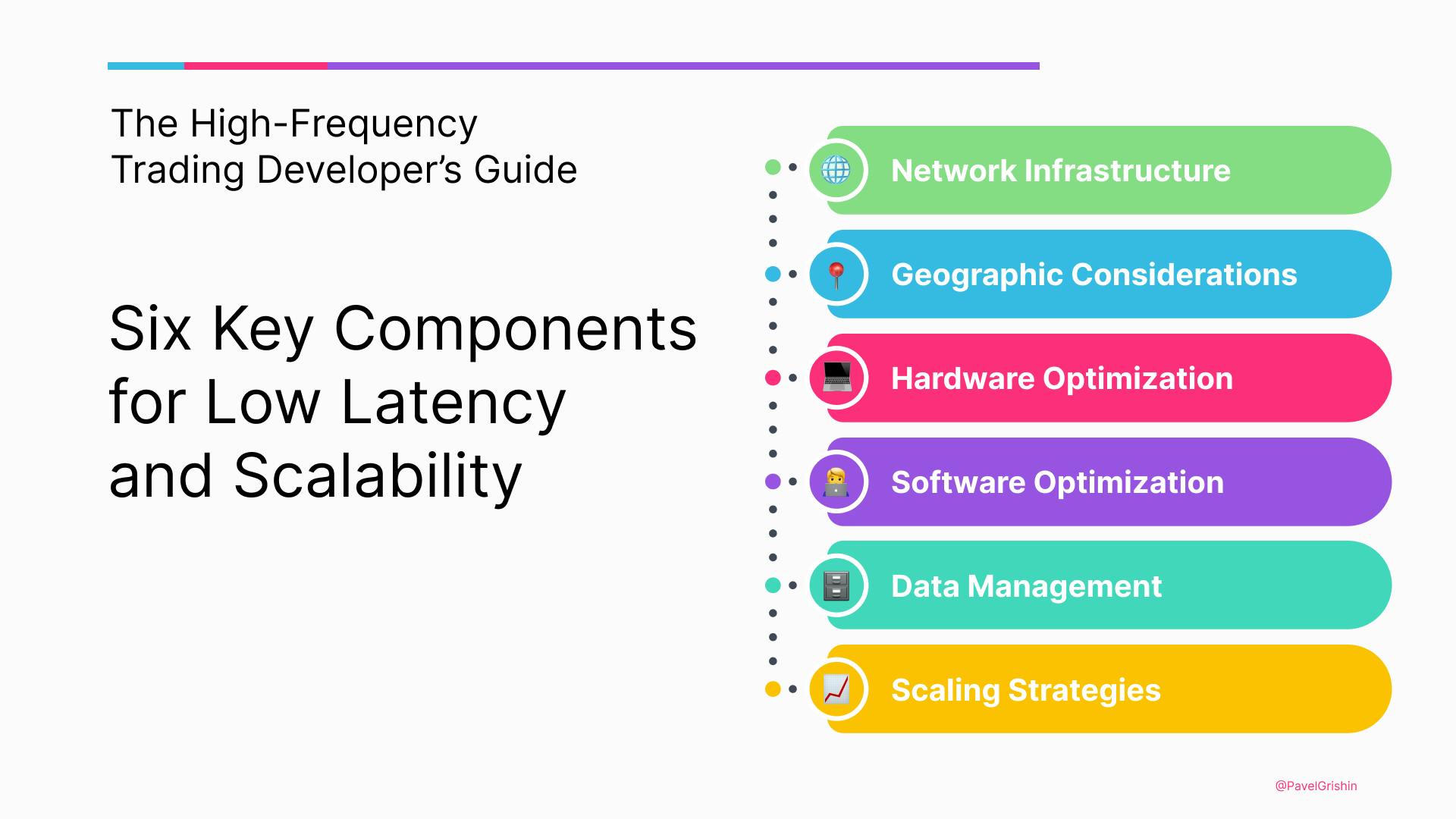
Reduce latency via VPS proximity to servers, dedicated lines, and broker co-location options in four ways. Key groups ensure under 5ms.
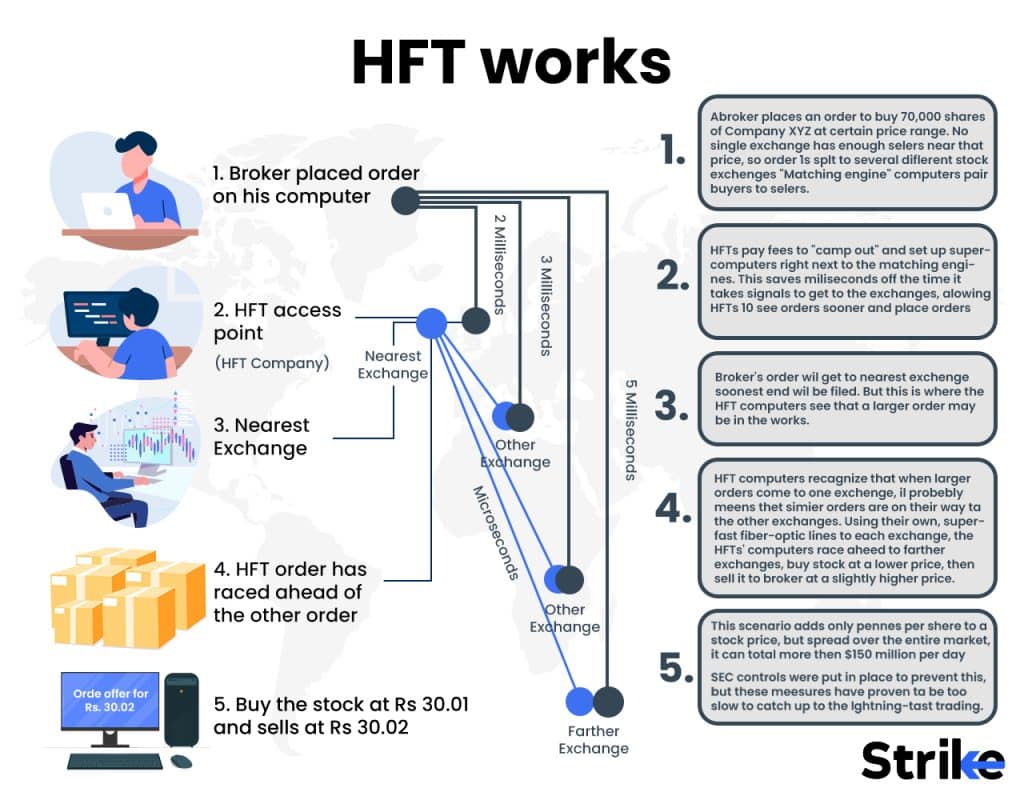
VPS proximity: Choose London VPS for EU brokers, ping test first. ForexVPS cuts 100ms off home setups.
Fiber connections: Upgrade to 1Gbps lines, avoid wireless.
Co-location alternatives: Brokers like Pepperstone offer server-side EAs, mimicking pro setups.
Software tweaks: Use lightweight code, disable MT5 visuals.
Example: Trader setup dropped from 80ms to 3ms, boosting profits 30% per backtests. Speedtest.net data validates proximity gains.
Unique Challenges and Advanced Comparisons in Retail HFT
Retail HFT traders encounter regulatory barriers, tech limitations, and capital gaps versus institutions, yet they succeed through specialized tools and adaptive strategies like triangular arbitrage.
Furthermore, these challenges highlight why retail traders must focus on niche adaptations to compete.
What Are the Regulatory Differences for Retail vs. Institutional HFT?
Retail high-frequency trading in forex operates under tighter rules than institutional HFT, which often enjoys exemptions due to scale and sophistication. Retail traders face leverage caps at 30:1 for major pairs under ESMA rules in Europe, while institutions access up to 500:1 or more through prime brokerage. FIFO execution rules mandate first-in-first-out order processing for retail brokers to prevent gaming, slowing down rapid HFT entries. MiFID II further restricts retail access by requiring best execution proofs and transparency reports, increasing compliance costs for small accounts.

Institutional HFT bypasses many of these via over-the-counter dealings and dark pool access. Retail must use regulated ECN brokers, exposing them to wider spreads during volatility. In the US, CFTC pattern day trader rules limit accounts under $25,000 to three trades per week, a non-issue for funded desks.
This setup raises a question: how do retail traders navigate these? Compliance tools like automated audit logs help, but they add latency.
To bridge gaps:
- Use offshore brokers cautiously for higher leverage, balancing risk with fund safety.
- Implement FIFO-compliant algos that prioritize queue management over speed.
- Monitor MiFID II updates via FCA or ESMA portals for timely adjustments.
How Does Retail HFT Compare to Prop Firm Trading?
Retail HFT demands personal capital and full risk exposure, unlike prop firm trading where firms provide funds and share profits. Retail traders need $10,000-$50,000 minimum for viable latency setups, while prop firms offer $50,000-$500,000 challenges with 80/20 profit splits favoring traders. Prop firms like FTMO or FundedNext supply low-latency VPS and data feeds, reducing retail’s tech burden.
Profit splits in prop trading cap upside at 10-20% firm take, but eliminate drawdown wipeouts common in retail. Tech access favors props with direct FIX connections to Tier 1 liquidity, versus retail’s cTrader or MT5 bridges prone to slippage.
Retail gains full ownership of strategies, fostering innovation absent in prop evaluations. Prop firms enforce strict rules like 5% daily loss limits, constraining aggressive HFT.
Why choose one over the other? Retail suits independent scalpers; props fit beginners scaling up.
Key disparities include:
- Capital outlay, where retail risks all versus prop’s evaluation fees.
- Tech equity, with props offering co-located servers retail must rent separately.
- Payout flexibility, as retail keeps 100% after costs but props delay withdrawals.
What Rare Tools Enable Retail HFT Like cTrader FIX API?
Rare tools level the playing field for retail HFT by mimicking institutional speed without massive budgets. cTrader’s FIX API allows direct market access with sub-100ms latency, bypassing broker delays for order book depth streaming. Custom bridges like JForex to FIX integrate with retail platforms, enabling algorithmic bursts on pairs like EUR/USD.

FPGA cards, such as those from Xilinx, process tick data on hardware for microsecond edges, affordable at $1,000-$5,000 versus institutional millions. Tools like QuantConnect’s Lean engine backtest HFT on cloud clusters, then deploy via VPS near exchanges.
These stand out because standard MT4/5 lacks true DMA. Retail traders stack them: FIX for execution, FPGA for signals, Python for logic.
Have you considered latency arbitrage? Tools like these exploit it legally within retail constraints.
Practical enablers:
- cTrader FIX for raw feed parsing and iceberg orders.
- Custom FPGA kits from Aldebaran for tick-level predictions.
- Bridges like Adaptive Connectivity’s for MT5-to-LMAX links.
What Are Case Studies of Successful Retail HFT Traders?
Successful retail HFT traders leverage backtested edges in overlooked areas, proving small accounts can thrive. One anonymized trader scaled $20,000 to $500,000 in two years via triangular arbitrage on exotic pairs like USD/TRY-ZAR/TRY-EUR/TRY, netting 0.5 pips per cycle at 100 trades/minute. Backtests on Tick Data Suite showed 65% win rate post-2018 Volmageddon, using cTrader API for latency under 50ms.
Another case involved a European retail coder who profited $1.2 million yearly from USD/JPY mean reversion during Asian sessions. Their strategy used FPGA filters to detect 1-tick reversals, avoiding FIFO pitfalls via smart queuing. Audited by Myfxbook, it endured 2022 rate hikes with 12% drawdown.
These examples share traits: VPS in Equinix NY4, Python/C# hybrids, and exotic focus where liquidity lags.
What separates winners? Rigorous walk-forward testing.
Notable adaptations:
- Triangular arb on crosses with 1:200 leverage via IC Markets.
- FPGA-driven scalping on news spikes, backtested 80% profitable.
- Multi-broker arb setups dodging single-venue spreads.
How Does HFT in Forex Differ from HFT in Equities or Crypto?
Forex HFT thrives on 24/5 global liquidity, unlike equities’ session limits or crypto’s wild swings. Forex offers tighter spreads averaging 0.1 pips on majors with infinite depth, versus equities’ 1-5 cent gaps and crypto’s 10-50% intraday volatility. No central exchange means OTC aggregation via FIX, enabling retail bursts absent in NYSE T+1 settlements.
Equities HFT relies on maker rebates from lit exchanges, a forex rarity where takers pay. Crypto HFT battles flash crashes on unregulated CEX like Binance, contrasting forex’s tiered liquidity from LPs.
Volatility suits forex latency plays during overlaps, equities for order flow prediction, crypto for pump detection.
Which market fits your setup? Forex demands constant monitoring, equities suit US hours.
Core contrasts:
- Liquidity patterns, forex 24/5 versus equities 9:30-4 PM ET.
- Spread behavior, forex compresses in London-NY overlap unlike crypto flares.
- Regulation, forex ESMA-capped versus crypto’s DEX freedoms.
