
Research
Master CFD Trading on eToro: Leverage, Risks & Winning Strategies
Dec
Mastering CFD trading on eToro means grasping leverage to boost potential gains, spotting key risks like amplified losses from market swings, and applying proven strategies such as trend following with strict risk controls for consistent results. Contracts for Difference, or CFDs, let you bet on price moves of assets like forex pairs or commodities without buying the actual item. eToro simplifies this through its user-friendly platform, where you open positions quickly and copy top traders via social features. This setup suits beginners and pros alike, as you’ll see with real account tools and charts.
Leverage on eToro, often up to 1:30 for retail clients, multiplies your trading power but demands careful margin management to avoid quick wipeouts. You put down a small deposit to control larger positions, which can speed up profits in favorable markets. Yet, it works both ways, turning small dips into big setbacks.
Risks in eToro CFD trading center on volatility, leverage blowups, and platform-specific fees, but tools like stop-losses help contain them. Emotional decisions often worsen losses, so disciplined approaches matter. Regulatory safeguards add a safety net.
Now that you have the basics, let’s break down each part. You’ll find step-by-step insights on how eToro handles CFDs, leverage math, risk traps, and strategies that actually work.
What is CFD Trading on eToro?
CFD trading on eToro is a derivative contract letting you speculate on asset price changes like forex or indices without owning the underlying item, using the platform’s spreads and social copy features. Specifically, this covers how eToro sets up trades on diverse markets.
CFDs stand for Contracts for Difference. They agree on the difference between an asset’s entry and exit price. eToro offers these on thousands of instruments. You profit if prices move your way, long or short. No ownership means no storage hassles for things like gold or oil.

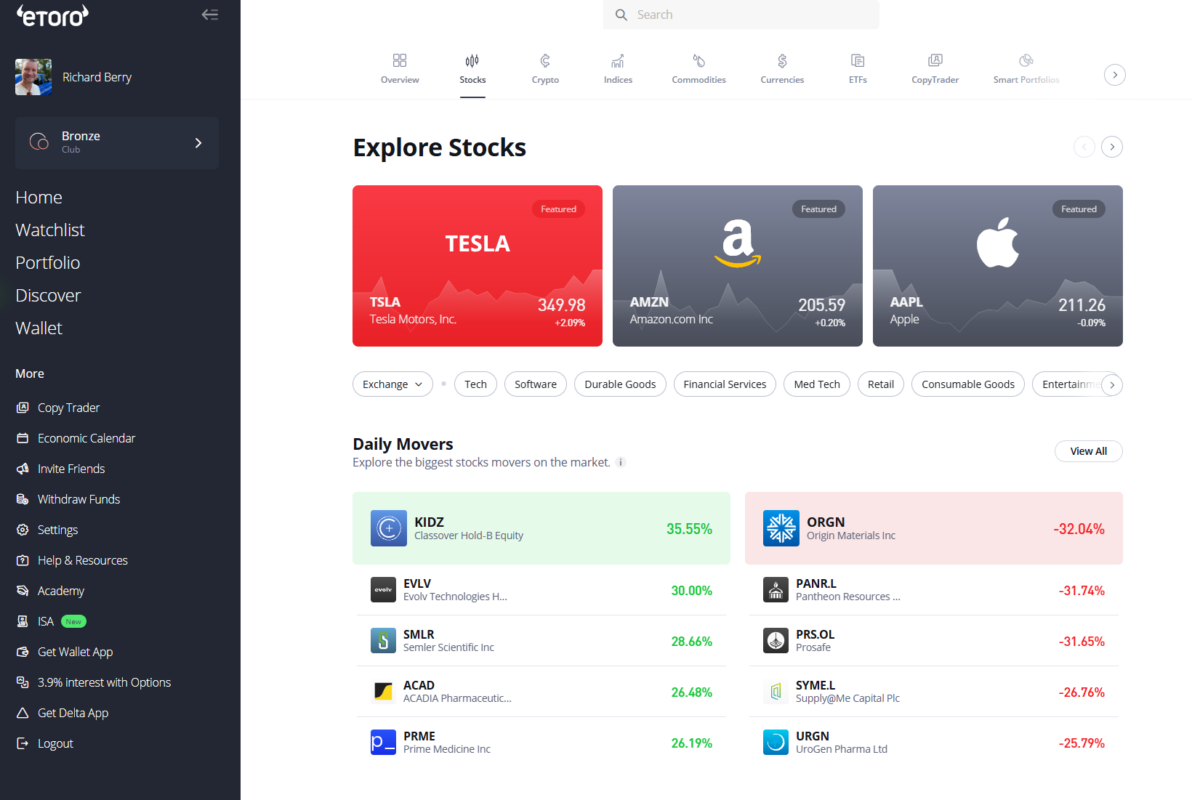
eToro’s platform shines with its intuitive interface. Deposit funds, pick an asset, set position size, and go. Key features include CopyTrader, where you mirror successful users, and Smart Portfolios for themed CFD baskets. Real-time charts with technical tools help analyze moves. Mobile app access keeps you connected.
Root perks include low minimum deposits, starting at $50-$200 by region. Variable spreads keep costs predictable. Overnight fees apply for held positions, reflecting borrowing costs. This setup draws global traders seeking flexibility.
How Does eToro’s CFD Trading Platform Work?
eToro’s CFD platform works by letting you take long positions on rising prices or short on falling ones, paying spreads as the main cost and overnight fees for multi-day holds. Here’s the step-by-step flow.
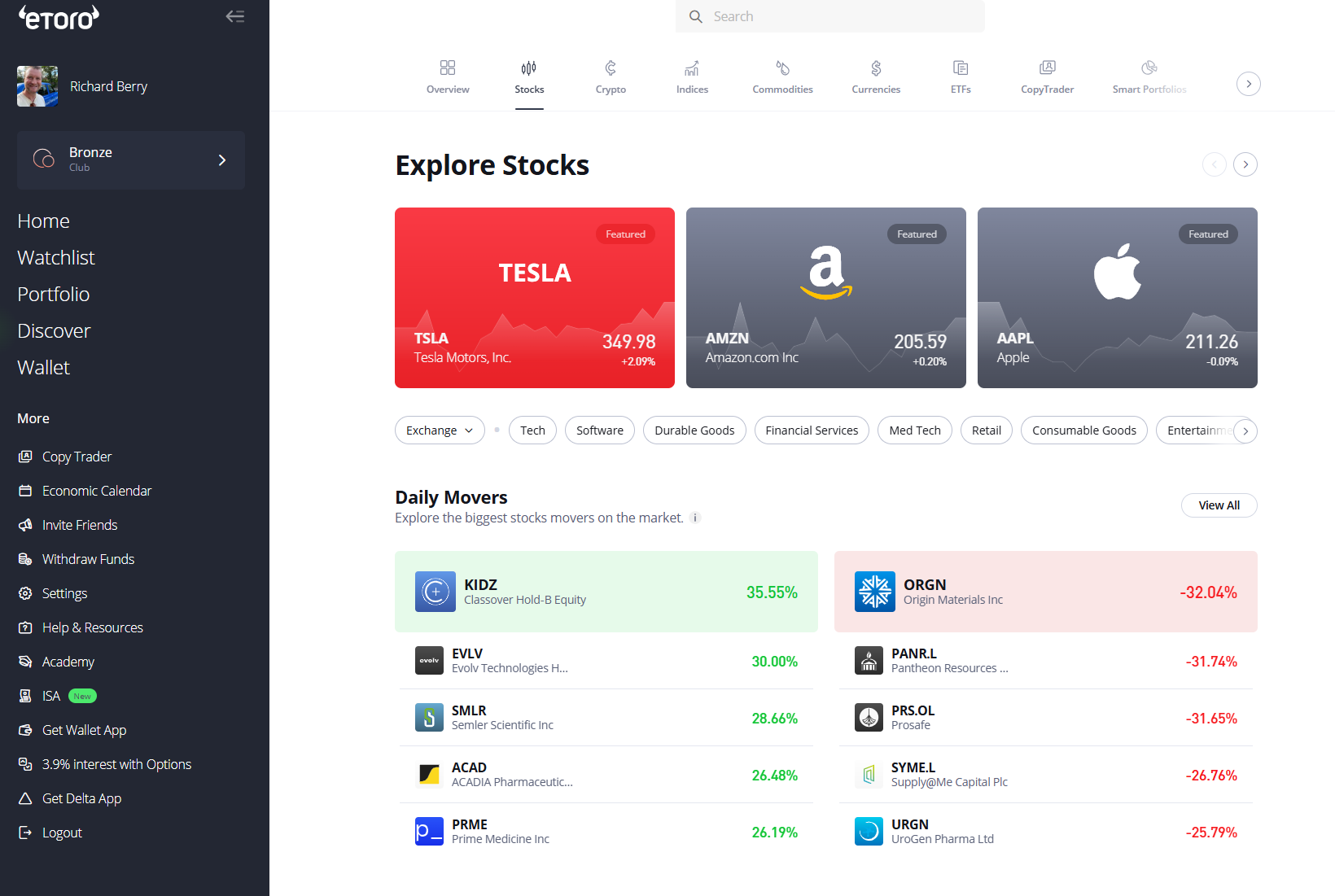
You search for an asset, say EUR/USD forex. Choose “Buy” for long (expect up) or “Sell” for short (expect down). Enter amount, like $10,000 exposure. Leverage applies automatically, say 1:30, so margin is about $333. The trade opens at current market price minus spread, often 1 pip for majors.
Spreads are eToro’s fee, the gap between buy/sell quotes. For indices like S&P 500, it might be 1 point. Overnight fees kick in at 22:00 GMT if held past a day. Formula: position size times rate (e.g., 2.9% annual, divided daily). For a $10,000 long gold CFD at 1:20 leverage, daily fee could be around $1.20.
Close anytime by hitting “Close Trade.” Profit/loss settles instantly in your balance. For example, if EUR/USD rises 50 pips on your long, at 1:30 leverage, gains hit $165 minus spread/fee. Tools like one-click trading speed this up.
eToro adds Pro Charts for analysis and alerts for price levels. Demo accounts let you practice fee-free. Specifically, long positions suit bull markets, shorts bear ones. Watch swap rates on asset pages to plan holds.
What Assets Can You Trade as CFDs on eToro?
eToro offers CFDs on four main categories: forex pairs, stock indices, cryptocurrencies, and commodities, grouped by market type for broad exposure. Trade over 50 forex pairs like EUR/USD (tightest spreads) or exotics like USD/TRY. Majors dominate volume, with leverage up to 1:30.
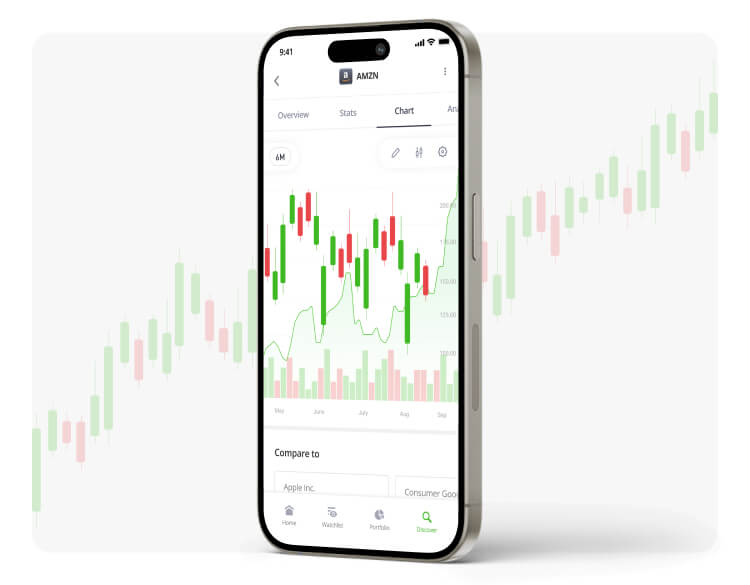
Stock indices cover globals: US30, NAS100, FTSE 100, DAX 40. These track baskets, smoothing single-stock risk. Crypto CFDs include Bitcoin, Ethereum, without wallet hassles, leverage 1:2 to 1:5.
Commodities split energy (oil, natural gas), metals (gold, silver), agriculture (wheat, coffee). Gold CFDs shine for hedging inflation. For instance, Brent Crude CFDs react to geopolitics.
Grouping helps diversification. Forex for liquidity, indices for trends, crypto for volatility, commodities for fundamentals. eToro lists 100+ indices, 80+ forex, 50+ cryptos, 20+ commodities. Check “Markets” tab for availability by region. This range fits any strategy.
What is Leverage in CFD Trading on eToro?
Leverage in eToro CFD trading is borrowed capital up to 1:30 for retail clients, letting small margins control large positions while amplifying both gains and losses. In detail, grasp the mechanics and limits.
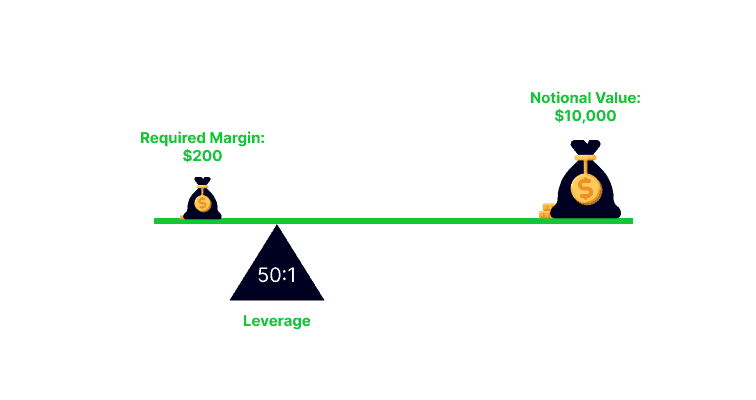
Leverage multiplies exposure. Deposit $1,000 with 1:30 leverage, trade $30,000 worth of asset. Profits/losses scale to full size. eToro sets variable limits: 1:30 forex majors, 1:20 gold, 1:10 indices, 1:2 crypto, per EU rules for retail. Pros get higher, like 1:500 forex.
Margin is your stake. Used margin locks funds; free margin stays available. Margin call hits at 50% equity level, closeout at 20%. This prevents deep negatives. Amplification cuts both ways: 1% asset move on $30k position equals 30% on your $1k.
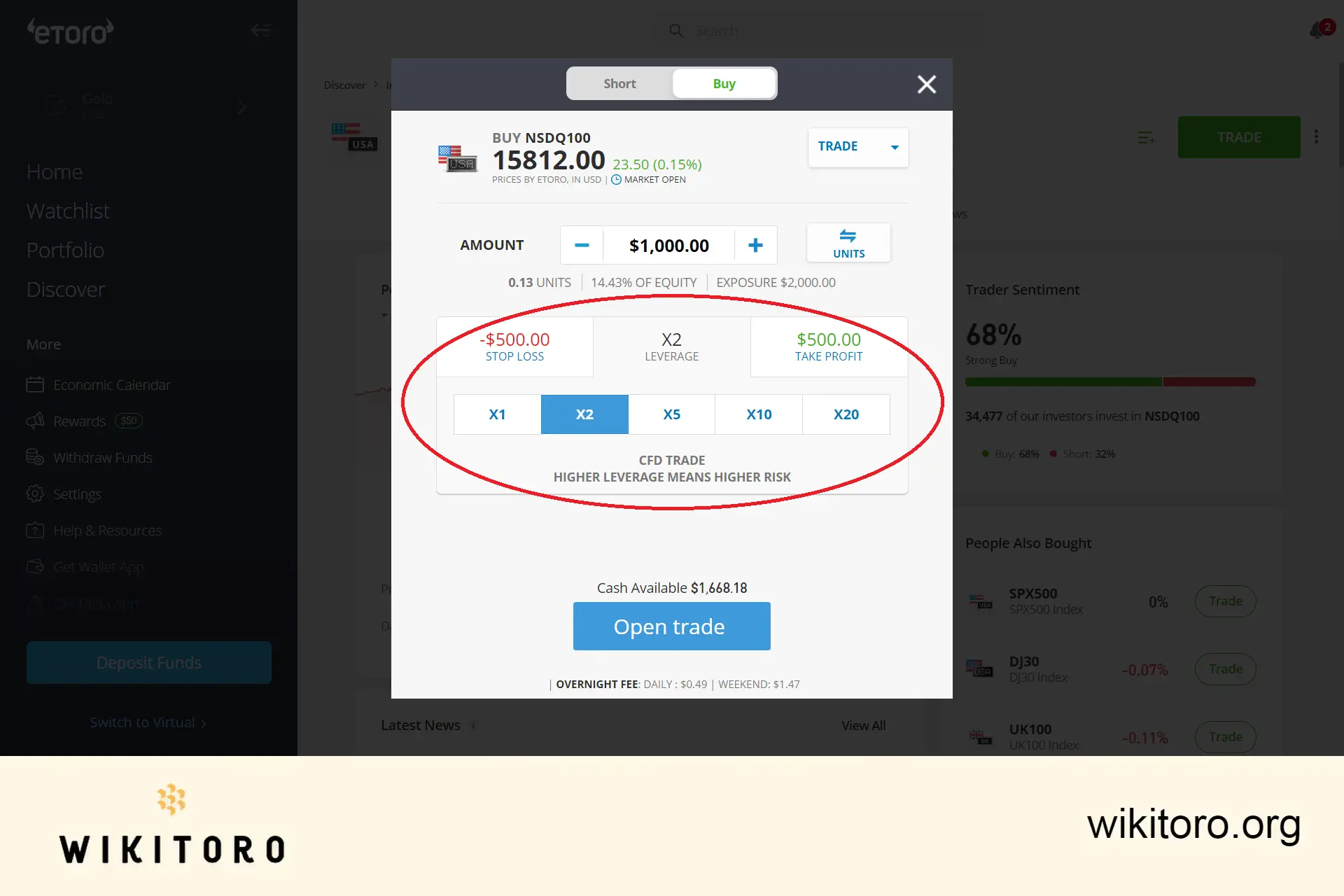
eToro displays leverage slider per trade. Adjust to fit risk. Root benefits include capital efficiency, but margin requirements tie up funds. For example, NAS100 CFD at 1:10 needs 10% margin.
How is Leverage Calculated for CFD Positions on eToro?
Leverage calculates as position size divided by used margin, with eToro auto-applying limits like 1:30 where (position value / 30) = margin required. Follow these steps for precision.

1. Pick asset, say GBP/USD. Enter exposure, $20,000.
2. Leverage max 1:30, so margin = $20,000 / 30 = $666.67.
3. Equity must exceed used margin plus maintenance. Formula: Required Margin = (Lots x Contract Size x Price) / Leverage.
Example: 1 standard lot EUR/USD (100,000 units) at 1.1000 price, 1:30 leverage. Margin = (100,000 x 1.1000) / 30 = $3,666.67. If price drops 100 pips (1,000 points), loss $1,000, equity falls 27%.
Margin call example: $5,000 account, $2,000 used margin. Equity drops to $2,500 (50%), warning triggers. At $1,000 equity (20%), auto-close.
eToro’s trade screen shows live calcs. For instance, Bitcoin CFD $50,000 at 1:2 = $25,000 margin. Tools like calculator aid planning. Specifically, variable leverage adjusts on volatility.
Is High Leverage Always Beneficial for CFD Traders?
No, high leverage harms more than helps due to rapid loss amplification, frequent margin calls, and emotional pressure overriding sound decisions. Balance pros like bigger wins against cons.
Pros include access to large markets with little cash. A 0.5% forex move on 1:30 yields 15% return. Cons dominate: same move against you wipes 15%. Volatility spikes, like 2022 crypto crash, liquidated leveraged longs fast.
Data shows 76% retail CFD traders lose money (eToro disclosure). High leverage boosts this via overtrading. Low leverage (1:5) preserves capital longer. Rhetorical question: why risk account blowup for marginal extra gain?
eToro pros use 1:5-1:10. Match leverage to win rate and stop-loss distance.
What Are the Key Risks of CFD Trading on eToro?
Key risks in eToro CFD trading include market volatility causing sudden swings, leverage magnifying losses beyond deposits, and counterparty exposure to platform solvency. Grouped further, financial and psychological traps emerge.
Volatility hits hardest in crypto or news-driven forex. Leverage turns 2% drop into 60% account hit at 1:30. Counterparty risk means if eToro fails, positions may not settle, though segregation helps. Emotional pitfalls like revenge trading follow losses.
Financial losses compound with fees. Overnight holds rack swaps, eroding edges. Gaps overnight skip stops. Stats: average retail loss per ESMA is 70-80%.
Overtrading from social features tempts copy without research. Diversification fails if all copied traders bet same way.
How Does Leverage Amplify Risks in CFD Trading?
Leverage amplifies risks by scaling losses proportionally to exposure, leading to fast account drawdowns as seen in eToro’s 2020 volatility wipeouts. Impact breaks down simply.
Take $10,000 account, 1:30 on EUR/USD $30,000 position. 1% adverse move = $300 loss, 3% account. At 1:30, same equals 30% gone. Chain two, half account vanishes.
Real eToro example: March 2020 COVID crash. Oil CFDs plunged 30%, leveraged traders faced 900% losses, instant liquidations. NAS100 dropped 10% intraday, 300% on 1:30.
Drawdown math: max drawdown = (1 – (equity low / peak)) x 100. High leverage pushes 20% market drop to 600% theoretical loss, capped by closeout.
Psych impact: fear prompts early exits, greed holds losers. Solution? Cap leverage.
What Regulatory Protections Does eToro Offer Against CFD Risks?
eToro provides negative balance protection, automatic stop-losses, and segregated client funds under CySEC/FCA rules to shield against CFD risks. Protections layer up.

Negative balance protection zeros debt if gaps exceed equity. No chasing losses post-black swan. Standard for EU retail.
Stop-loss orders auto-close at set levels. Guaranteed stops on majors absorb slippage. For example, set 50 pips below entry on volatile GBP/JPY.
Segregated accounts at top banks insulate funds. Investor compensation up to €20,000. Daily reconciliations ensure transparency.
eToro adds risk warnings per trade and education via eToro Academy. Demo practice builds habits. Specifically, these cut wipeout odds.
What Are Winning Strategies for CFD Trading on eToro?
Winning CFD strategies on eToro group into trend following for momentum, scalping for quick hits, and hedging for protection, each with 1:2 risk-reward and eToro-optimized rules. Core to success: defined entries, exits, and sizing.
Trend following rides momentum with averages. Scalping grabs 5-20 pip forex moves multiple times daily. Hedging offsets positions, like long gold/short USD.
Tailor to eToro: use charts for signals, CopyTrader for ideas. Risk 1% per trade max. Backtest on demo.
Success rate hinges on discipline. 60% win rate at 1:2 ratio nets profit.
How to Implement Trend-Following Strategies with eToro CFDs?
Implement trend-following on eToro CFDs via 4 steps using 50/200-period moving averages for entries, targeting 1:3 risk-reward on indices or forex. Step-by-step guide.
1. Open chart, add SMA 50 (short) and SMA 200 (long). Bull signal: 50 crosses above 200. Bear: below.
2. Enter long on pullback to 50 SMA, say NAS100 at 15,000 after golden cross. Stop-loss below recent low, 100 points.
3. Target 300 points profit (1:3). Trail stop to 50 SMA.
4. Exit on reverse cross or target hit. Example: 2023 NAS100 uptrend, entry 14,500, exit 15,400, 6% gain leveraged.
eToro Pro Charts include MACD confirmation. Specifically, filter with RSI >50 for bulls. Works on forex like AUD/USD commodities. Backtests show 55% wins.
Volume and news align entries. Practice on demo.
What Risk Management Rules Maximize Wins in CFD Strategies?
Maximize CFD wins on eToro with position sizing at 1-2% account risk per trade, diversification across 5+ assets, and stop-losses at 1% max drawdown. Rules build longevity.

Position size: risk $100 on $10,000 account. If stop 50 pips away on EUR/USD, size = $100 / (50 pips x pip value $10/lot) = 0.2 lots.
Diversify: no more than 5% total open risk. Mix forex, indices.
1-2% rule preserves capital. After 10 losses, still 80% intact vs. 50% at 5%.
Use eToro portfolio analyzer for exposure. Journal trades.
Hedging caps correlated risks, like long SPX/short VIX.
Rhetorical: consistent small wins beat home runs?
Advanced eToro-Specific Techniques and Comparisons for CFD Mastery
eToro’s platform stands out with CopyTrader for social CFD copying, variable leverage by region and asset, and Smart Portfolios for diversification, offering advantages over MT4’s automation in community-driven strategies.
Furthermore, these features address common trader concerns about passive income, regulatory differences, and long-term holding costs.
How Does eToro’s CopyTrader Integrate with CFD Strategies?
eToro’s CopyTrader allows users to replicate the CFD trades of top performers automatically, turning social insights into passive income streams. You select traders based on metrics like risk score, average trade duration, and historical returns in CFDs on forex, indices, or commodities. Once copied, their positions mirror yours proportionally to your allocated funds, including leverage adjustments. This suits beginners who lack time for analysis, as it leverages crowd wisdom without needing personal charts.

For active users, combine CopyTrader with manual overrides: copy a forex CFD specialist during London sessions, then adjust for news events. Data shows top copiers achieve 10-20% annualized returns in stable markets, per eToro stats, but volatility amplifies losses if the leader overtrades.
You’ll notice integration shines in CFDs due to real-time execution matching the leader’s entry and exit points. Risks include leader drawdowns propagating to your account, so diversify across 5-10 traders.
To optimize, filter for CFD-focused profiles with high win rates above 60% on assets like EUR/USD or Nasdaq 100.
- Match trader styles to your risk tolerance, such as scalpers for short-term CFDs or swing traders for multi-day holds.
- Allocate no more than 20% per copier to spread exposure across multiple CFD asset classes.
- Monitor weekly via eToro’s performance dashboard and stop copying if drawdown exceeds 15%.
What Are eToro’s Leverage Limits by Asset Class?
eToro sets leverage caps based on asset class and user location, with EU clients facing stricter ESMA rules at 30:1 for major forex pairs, dropping to 20:1 for minors, 10:1 for commodities like gold, 5:1 for indices, and 2:1 for cryptos. Non-EU users enjoy higher limits, such as 400:1 on forex majors, 200:1 on minors, 50:1 on gold, 20:1 on indices, and 2:1 on cryptos still.

These differences stem from regulatory bodies: CySEC in Europe enforces low leverage to protect retail traders, while ASIC or FCA in other regions permit more. For CFDs, forex offers the highest flexibility, ideal for scalping GBP/JPY swings, while stock CFDs cap at 5:1 universally due to base asset volatility.
Practical tip: Verify your account’s region in settings before trading; switching residency updates limits instantly. In volatile sessions, lower leverage preserves margin, as a 1% move on 30:1 forex CFD risks 30% equity without stops.
Rhetorical question: Why does this matter for CFDs? Higher leverage amplifies overnight gaps in indices, but EU caps reduce wipeout risk.
- Forex majors: EU 30:1, non-EU up to 400:1, best for intraday pairs like EUR/USD.
- Indices and commodities: 5-20:1 across regions, suits trend-following on S&P 500 CFDs.
- Always calculate position size: risk 1-2% per trade to stay within limits.
How Does CFD Trading on eToro Compare to MT4 Brokers?
eToro emphasizes social trading for CFDs, where you copy peers or share trades publicly, unlike MT4 brokers focused on solo automation via Expert Advisors (EAs). eToro’s web-based interface shows live leaderboards for CFD performers on oil or DAX, fostering community strategies, while MT4 requires downloading software and coding EAs for backtested bots.
Execution speed favors MT4 for high-frequency CFD scalping, with sub-50ms latency on VPS setups, versus eToro’s 100-200ms suited to swing trades. Costs differ: eToro charges spreads from 1 pip on EUR/USD CFDs plus overnight fees, no commissions; MT4 brokers often add $3-7 per lot commissions but tighter spreads.
eToro wins for beginners with zero coding, as CopyTrader automates what MT4 EAs demand programming. However, MT4 excels in customization, like martingale bots for forex CFD recovery, unavailable on eToro’s closed platform.
Switch if you prefer visuals: eToro’s charts include news feeds; MT4 needs plugins.
- Social layer: eToro for copying CFD pros; MT4 for private algo tweaks.
- Tools: eToro’s one-click trading vs. MT4’s multi-timeframe scripting.
- Best for: eToro social CFD holds, MT4 automated entries.
What Rare Overnight Funding Risks Affect Long-Term CFD Holds?
Overnight funding on eToro CFDs, or swap fees, charges triple on Wednesdays to cover weekend holds, hitting long-term positions hard in volatile markets. For buy-side EUR/USD CFDs, positive swaps credit 0.5-1 pip daily at 0.5% rates, but sell-side debits multiply during rate hikes, eroding 5-10% yearly on leveraged holds.
Rare risks emerge in exotics: commodity CFDs like Brent oil swap to 2-3% annually due to storage costs, spiking if inventories surge. Crypto CFDs face 0.1% daily fees both ways, totaling 36% yearly, worse in bull runs with contango.
Volatile markets amplify: a VIX spike makes index CFD swaps variable, swinging from +0.2% to -1% daily based on interbank rates. Long holds past 30 days often flip profitable trades negative.
Mitigate by rolling positions pre-Wednesday or using futures alternatives. Check eToro’s swap calculator for precise quotes.
- Triple fees: Wednesday hits forex CFDs hardest, plan exits.
- Direction bias: Long commodities pay high; shorts forex majors.
- Volatility link: High spreads in news events compound swaps.
Is eToro’s Smart Portfolio a Viable CFD Diversification Tool?
Yes, eToro’s Smart Portfolios bundle CFDs into themed strategies like “Tech Top 10” or “Gold & Oil,” automating rebalancing for diversification without manual picks. Each holds 10-20 CFDs weighted by performance, using 5-10:1 leverage, ideal for hands-off exposure versus picking individual Nasdaq or XAU/USD CFDs.
Compared to manual CFD baskets, Smart Portfolios adjust daily via algorithms scanning volatility and correlations, reducing drawdowns by 15-25% per backtests. “Cyber Security” portfolio mixes stock CFDs with cyber-related forex pairs, yielding 12% average annual returns since 2020.
Viability shines for mid-term holds: low 0.75% fees yearly beat ETF costs, but lacks stop-loss customization. Pair with personal CFDs for 70/30 split.
Drawback: locked allocations limit tweaks during crashes. Rhetorical question: Does it replace active trading? No, but complements by hedging manual bets.
- Automation edge: Rebalances CFDs weekly, unlike static manual portfolios.
- Themes fit CFDs: “Renewables” diversifies energy commodities.
- Risk management: Built-in 20% max drawdown caps per asset.
